
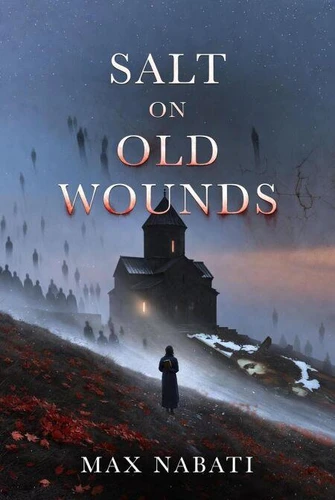
Salt on Old Wounds. Genre Haven, #5
Par :Formats :
Disponible dans votre compte client Decitre ou Furet du Nord dès validation de votre commande. Le format ePub est :
- Compatible avec une lecture sur My Vivlio (smartphone, tablette, ordinateur)
- Compatible avec une lecture sur liseuses Vivlio
- Pour les liseuses autres que Vivlio, vous devez utiliser le logiciel Adobe Digital Edition. Non compatible avec la lecture sur les liseuses Kindle, Remarkable et Sony
 , qui est-ce ?
Notre partenaire de plateforme de lecture numérique où vous retrouverez l'ensemble de vos ebooks gratuitement
Pour en savoir plus sur nos ebooks, consultez notre aide en ligne ici
C'est si simple ! Lisez votre ebook avec l'app Vivlio sur votre tablette, mobile ou ordinateur :

- FormatePub
- ISBN8232430146
- EAN9798232430146
- Date de parution01/12/2025
- Protection num.pas de protection
- Infos supplémentairesepub
- ÉditeurDraft2Digital
Résumé
In "Salt on Old Wounds, " Max Nabati masterfully weaves a tapestry of haunting tales drawn from the shadowed corners of history and the human soul. Inspired by solitary journeys through the rugged landscapes of West Azerbaijan and the echoing halls of Rome's ancient refectories, these stories emerge from the author's intimate encounters with places where the past refuses to fade. Nabati takes real historical sites-crumbling churches perched on windswept hills, damp monastery walls bearing the weight of unfinished masterpieces, and forgotten battlefields where kings once clashed-and infuses them with a potent blend of the supernatural and the profoundly personal.
Each narrative rubs metaphorical salt into lingering scars, reopening questions about faith, betrayal, memory, and the thin veil between the living and the echoes of those long gone. The collection begins in the misty hills of Chaldoran, where an ancient church stands as a silent guardian of secrets, its stones whispering tales of devotion and loss. Here, a curious historian is drawn into the town's quiet rhythms, where locals share guarded warnings over steaming tea, and festivals blur the line between celebration and something more ethereal.
Nabati's prose evokes the crisp autumn air, the flicker of candlelight on stained glass, and the chill of unseen presences, inviting readers to feel the pull of history's unresolved mysteries. Shifting to the Renaissance splendor of Milan, another story delves into the tormented mind of a genius painter grappling with his magnum opus on a deteriorating wall. Fragmented reflections on childhood under starry skies, dreams of flight, and the sting of unfinished ambitions paint a portrait of inner turmoil, where art becomes a mirror to the soul's cracks.
Nabati captures the sensory details-the scent of fresh paint mingling with bread and wine, the peel of frescoes like falling tears-blurring the boundaries between creator and creation, reality and delusion. Throughout the book, Nabati explores themes of haunting in its many forms: the literal ghosts that linger in sacred spaces, the metaphorical specters of regret and betrayal, and the ordinary aches of memory that bind us to the past.
Drawing from real names and sorrows, such as the echoes of Safavid battles or the quiet decay of Leonardo's works, the author transforms historical fragments into vivid, stinging narratives. Some tales pulse with otherworldly energy, where shadows stir and voices plead from the void; others ache with the quiet pain of human frailty, reminding us that history is not a distant relic but a living wound.
Nabati's writing is poetic and immersive, laced with sensory richness that transports readers to cobblestone streets, incense-filled chapels, and moonlit crypts. Yet, it's the emotional depth that lingers-the way these stories probe the places where pain persists, urging us to listen to the ruins' voices. Perfect for fans of atmospheric fiction like that of Shirley Jackson or Hilary Mantel, "Salt on Old Wounds" is a meditation on how the past shapes us, often against our will.
If the sting of recognition hits while turning the pages, it's a sign that Nabati's salt has found its mark, reopening old questions in new, unforgettable ways.
Each narrative rubs metaphorical salt into lingering scars, reopening questions about faith, betrayal, memory, and the thin veil between the living and the echoes of those long gone. The collection begins in the misty hills of Chaldoran, where an ancient church stands as a silent guardian of secrets, its stones whispering tales of devotion and loss. Here, a curious historian is drawn into the town's quiet rhythms, where locals share guarded warnings over steaming tea, and festivals blur the line between celebration and something more ethereal.
Nabati's prose evokes the crisp autumn air, the flicker of candlelight on stained glass, and the chill of unseen presences, inviting readers to feel the pull of history's unresolved mysteries. Shifting to the Renaissance splendor of Milan, another story delves into the tormented mind of a genius painter grappling with his magnum opus on a deteriorating wall. Fragmented reflections on childhood under starry skies, dreams of flight, and the sting of unfinished ambitions paint a portrait of inner turmoil, where art becomes a mirror to the soul's cracks.
Nabati captures the sensory details-the scent of fresh paint mingling with bread and wine, the peel of frescoes like falling tears-blurring the boundaries between creator and creation, reality and delusion. Throughout the book, Nabati explores themes of haunting in its many forms: the literal ghosts that linger in sacred spaces, the metaphorical specters of regret and betrayal, and the ordinary aches of memory that bind us to the past.
Drawing from real names and sorrows, such as the echoes of Safavid battles or the quiet decay of Leonardo's works, the author transforms historical fragments into vivid, stinging narratives. Some tales pulse with otherworldly energy, where shadows stir and voices plead from the void; others ache with the quiet pain of human frailty, reminding us that history is not a distant relic but a living wound.
Nabati's writing is poetic and immersive, laced with sensory richness that transports readers to cobblestone streets, incense-filled chapels, and moonlit crypts. Yet, it's the emotional depth that lingers-the way these stories probe the places where pain persists, urging us to listen to the ruins' voices. Perfect for fans of atmospheric fiction like that of Shirley Jackson or Hilary Mantel, "Salt on Old Wounds" is a meditation on how the past shapes us, often against our will.
If the sting of recognition hits while turning the pages, it's a sign that Nabati's salt has found its mark, reopening old questions in new, unforgettable ways.
A propos de Max Nabati

The Marble Winter
E-book
2,99 €


3,49 €

The Salt Wind of Khark
E-book
4,49 €
Once, Out of Venice
E-book
3,49 €

The Cube Of Wishes
E-book
8,49 €
Once, in Venice
E-book
3,49 €
8,49 €

The Forty-Minutes Sunset
E-book
3,49 €
2,99 €

3,49 €

3,49 €
The Cebu Hours
E-book
4,49 €
2,99 €

Down Under, Down Below
E-book
2,99 €

6,99 €