
Max (Shahrooz) Nabati is a global citizen and an accomplished author. He has explored many countries, immersed himself in diverse societies, cultures, and natural wonders. These journeys have deeply inspired his creative work, leading him to publish short stories and novels across various genres, with several of his works released over the past decade.
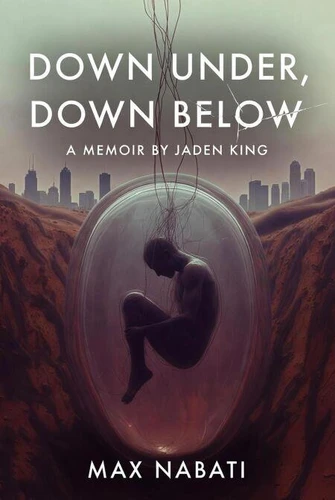
Down Under, Down Below
Par :Formats :
Disponible dans votre compte client Decitre ou Furet du Nord dès validation de votre commande. Le format ePub est :
- Compatible avec une lecture sur My Vivlio (smartphone, tablette, ordinateur)
- Compatible avec une lecture sur liseuses Vivlio
- Pour les liseuses autres que Vivlio, vous devez utiliser le logiciel Adobe Digital Edition. Non compatible avec la lecture sur les liseuses Kindle, Remarkable et Sony
 , qui est-ce ?
Notre partenaire de plateforme de lecture numérique où vous retrouverez l'ensemble de vos ebooks gratuitement
Pour en savoir plus sur nos ebooks, consultez notre aide en ligne ici
C'est si simple ! Lisez votre ebook avec l'app Vivlio sur votre tablette, mobile ou ordinateur :

- FormatePub
- ISBN8232784041
- EAN9798232784041
- Date de parution09/12/2025
- Protection num.pas de protection
- Infos supplémentairesepub
- ÉditeurDraft2Digital
Résumé
In a near-future Australia transformed by subtle yet profound social shifts, Jaden King's memoir "Down Under, Down Below" delves into the intimate unraveling of a man's life amid a society restructured around new ideals of harmony and gender roles. Beginning in the sun-drenched suburbs of Sydney, King paints a vivid portrait of domestic life in a world where traditional expectations have been upended.
As a devoted husband and father, he navigates the quiet pressures of conformity, from state-mandated guidelines on behavior to the everyday scrutiny that shapes public and private spaces. The narrative unfolds as a raw exploration of identity, love, and loss, where love is portrayed not as a savior but as a complex force that can both bind and dissolve. King's journey takes him from the familiar confines of home to the stark realities of institutional intervention, where diagnoses and treatments blur the lines between care and control.
He grapples with a diagnosis that labels his innermost struggles as societal threats, leading to a profound confrontation with his own sense of self. The memoir shifts into a haunting odyssey of exile, wandering through global cities like Bangkok, Berlin, and Buenos Aires, where fleeting connections become mirrors reflecting his fractured psyche. Each locale serves as a backdrop for King's introspective reckoning, blending sensory details-the humid chaos of street markets, the cold precision of urban nights-with philosophical musings on power, desire, and human resilience.
Written with unflinching prose that evokes both clinical detachment and poetic intensity, the book transforms personal anecdote into a broader allegory for systemic change. King's voice is one of quiet defiance, dissecting the "Great Womb" of his homeland-a metaphor for an all-encompassing order that nurtures some while suffocating others. Themes of memory, erasure, and rebirth weave through the pages, as he reconstructs his past not for redemption, but as an act of preservation.
The act of writing itself becomes a central motif, a laborious process undertaken in a Lisbon room, where the mundane details of ink and paper ground his existential quest."Down Under, Down Below" is more than a personal story; it's a speculative lens on how revolutions can reshape the soul. Published clandestinely after appearing on a shadowy server, it challenges readers to question the benevolence of progress and the cost of enforced peace.
King's narrative resonates with anyone who has felt the weight of societal expectations, offering a stark reminder that true harmony may lie in acknowledging discord. This banned text, treated as seditious in its homeland, stands as a testament to the enduring power of individual truth in the face of collective narrative.
As a devoted husband and father, he navigates the quiet pressures of conformity, from state-mandated guidelines on behavior to the everyday scrutiny that shapes public and private spaces. The narrative unfolds as a raw exploration of identity, love, and loss, where love is portrayed not as a savior but as a complex force that can both bind and dissolve. King's journey takes him from the familiar confines of home to the stark realities of institutional intervention, where diagnoses and treatments blur the lines between care and control.
He grapples with a diagnosis that labels his innermost struggles as societal threats, leading to a profound confrontation with his own sense of self. The memoir shifts into a haunting odyssey of exile, wandering through global cities like Bangkok, Berlin, and Buenos Aires, where fleeting connections become mirrors reflecting his fractured psyche. Each locale serves as a backdrop for King's introspective reckoning, blending sensory details-the humid chaos of street markets, the cold precision of urban nights-with philosophical musings on power, desire, and human resilience.
Written with unflinching prose that evokes both clinical detachment and poetic intensity, the book transforms personal anecdote into a broader allegory for systemic change. King's voice is one of quiet defiance, dissecting the "Great Womb" of his homeland-a metaphor for an all-encompassing order that nurtures some while suffocating others. Themes of memory, erasure, and rebirth weave through the pages, as he reconstructs his past not for redemption, but as an act of preservation.
The act of writing itself becomes a central motif, a laborious process undertaken in a Lisbon room, where the mundane details of ink and paper ground his existential quest."Down Under, Down Below" is more than a personal story; it's a speculative lens on how revolutions can reshape the soul. Published clandestinely after appearing on a shadowy server, it challenges readers to question the benevolence of progress and the cost of enforced peace.
King's narrative resonates with anyone who has felt the weight of societal expectations, offering a stark reminder that true harmony may lie in acknowledging discord. This banned text, treated as seditious in its homeland, stands as a testament to the enduring power of individual truth in the face of collective narrative.
A propos de Max Nabati



The Marble Winter
E-book
2,99 €




3,49 €

The Salt Wind of Khark
E-book
4,49 €

Once, Out of Venice
E-book
3,49 €

The Cube Of Wishes
E-book
8,49 €

Once, in Venice
E-book
3,49 €
8,49 €

The Forty-Minutes Sunset
E-book
3,49 €
2,99 €

3,49 €

Hyphen India
E-book
4,49 €

3,49 €

The Cebu Hours
E-book
4,49 €

2,99 €