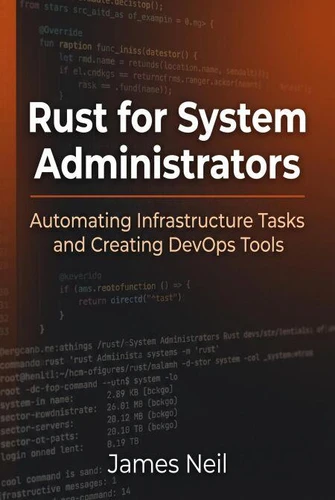
Rust for System Administrators: Automating Infrastructure Tasks and Creating DevOps Tools. Practical Rust for Developers
Par :Formats :
Disponible dans votre compte client Decitre ou Furet du Nord dès validation de votre commande. Le format ePub protégé est :
- Compatible avec une lecture sur My Vivlio (smartphone, tablette, ordinateur)
- Compatible avec une lecture sur liseuses Vivlio
- Pour les liseuses autres que Vivlio, vous devez utiliser le logiciel Adobe Digital Edition. Non compatible avec la lecture sur les liseuses Kindle, Remarkable et Sony
- Non compatible avec un achat hors France métropolitaine
 , qui est-ce ?
Notre partenaire de plateforme de lecture numérique où vous retrouverez l'ensemble de vos ebooks gratuitement
Pour en savoir plus sur nos ebooks, consultez notre aide en ligne ici
C'est si simple ! Lisez votre ebook avec l'app Vivlio sur votre tablette, mobile ou ordinateur :

- FormatePub
- ISBN8235213364
- EAN9798235213364
- Date de parution25/04/2026
- Protection num.Adobe DRM
- Infos supplémentairesepub
- ÉditeurIoakim Ioakim
Résumé
Stop Patching Brittle Scripts. Build Infrastructure That Never Breaks. If you manage servers, automate deployments, or maintain infrastructure at scale, you already know the risk. A Bash script that worked perfectly for months suddenly fails at the worst moment, leaving your system in an unknown state. Python tools break when runtime versions change. Dependency conflicts appear without warning. There has to be a better way.
Rust for System Administrators is a hands-on guide for DevOps engineers, sysadmins, and Site Reliability Engineers who want to build automation tools that are fast, safe, and completely dependable. No computer science degree required. If you can navigate a Linux terminal and write a shell script, you are ready to start. What You Will Learn Set up a professional Rust development environment using Cargo and rustup Build production-grade command-line interfaces with argument parsing, subcommands, and auto-generated help menus Automate file system operations and batch processing without exhausting server memory Manage users, groups, permissions, and background processes via direct POSIX system calls Interact with cloud and infrastructure APIs, handle HTTP requests, and automate SSH execution Build structured logging, monitoring, and alerting tools for full production observability Package, distribute, and security-harden Rust binaries for deployment on any Linux environment Why Rust Changes Everything for InfrastructureRust compiles down to a single, statically linked binary.
No runtimes. No virtual environments. No dependency conflicts. Build it once and deploy it anywhere. The compiler enforces memory safety, prevents data races, and forces explicit error handling, ensuring your tools will not silently fail halfway through a critical deployment. This book teaches Rust through the lens of real infrastructure work. Every concept is grounded in practical tasks system administrators perform daily: replacing fragile shell pipelines, querying cloud APIs, managing remote servers, and building continuous monitoring agents that run reliably for months without intervention.
Who This Book Is ForThis guide is written for Linux system administrators, DevOps engineers, and SRE professionals ready to move beyond scripting languages. No prior experience with Rust, C, or systems programming is required. You need a working knowledge of Linux, some scripting experience, and a desire to build tools that scale. Build the foundation your infrastructure deserves.
Rust for System Administrators is a hands-on guide for DevOps engineers, sysadmins, and Site Reliability Engineers who want to build automation tools that are fast, safe, and completely dependable. No computer science degree required. If you can navigate a Linux terminal and write a shell script, you are ready to start. What You Will Learn Set up a professional Rust development environment using Cargo and rustup Build production-grade command-line interfaces with argument parsing, subcommands, and auto-generated help menus Automate file system operations and batch processing without exhausting server memory Manage users, groups, permissions, and background processes via direct POSIX system calls Interact with cloud and infrastructure APIs, handle HTTP requests, and automate SSH execution Build structured logging, monitoring, and alerting tools for full production observability Package, distribute, and security-harden Rust binaries for deployment on any Linux environment Why Rust Changes Everything for InfrastructureRust compiles down to a single, statically linked binary.
No runtimes. No virtual environments. No dependency conflicts. Build it once and deploy it anywhere. The compiler enforces memory safety, prevents data races, and forces explicit error handling, ensuring your tools will not silently fail halfway through a critical deployment. This book teaches Rust through the lens of real infrastructure work. Every concept is grounded in practical tasks system administrators perform daily: replacing fragile shell pipelines, querying cloud APIs, managing remote servers, and building continuous monitoring agents that run reliably for months without intervention.
Who This Book Is ForThis guide is written for Linux system administrators, DevOps engineers, and SRE professionals ready to move beyond scripting languages. No prior experience with Rust, C, or systems programming is required. You need a working knowledge of Linux, some scripting experience, and a desire to build tools that scale. Build the foundation your infrastructure deserves.