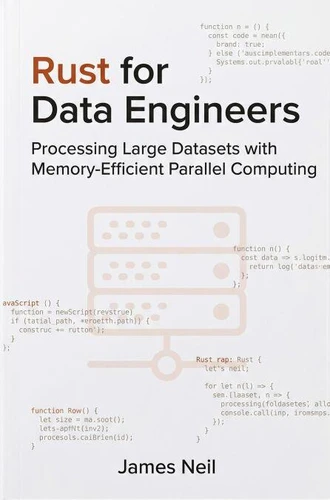
Rust for Data Engineers: Processing Large Datasets with Memory-Efficient Parallel Computing. Practical Rust for Developers
Par :Formats :
Disponible dans votre compte client Decitre ou Furet du Nord dès validation de votre commande. Le format ePub protégé est :
- Compatible avec une lecture sur My Vivlio (smartphone, tablette, ordinateur)
- Compatible avec une lecture sur liseuses Vivlio
- Pour les liseuses autres que Vivlio, vous devez utiliser le logiciel Adobe Digital Edition. Non compatible avec la lecture sur les liseuses Kindle, Remarkable et Sony
- Non compatible avec un achat hors France métropolitaine
 , qui est-ce ?
Notre partenaire de plateforme de lecture numérique où vous retrouverez l'ensemble de vos ebooks gratuitement
Pour en savoir plus sur nos ebooks, consultez notre aide en ligne ici
C'est si simple ! Lisez votre ebook avec l'app Vivlio sur votre tablette, mobile ou ordinateur :

- FormatePub
- ISBN8235415508
- EAN9798235415508
- Date de parution27/04/2026
- Protection num.Adobe DRM
- Infos supplémentairesepub
- ÉditeurIoakim Ioakim
Résumé
Transform your data infrastructure with the speed and safety of Rust. In the era of massive datasets, data engineers are hitting the performance limits of traditional programming languages. Memory leaks, garbage collection pauses, and concurrency bottlenecks can cripple large pipelines. Rust offers a paradigm shift. By combining low level hardware control with high level memory safety, Rust empowers you to build concurrent systems that process terabytes of data without sacrificing reliability.
This comprehensive guide bridges the gap between systems programming and data engineering. You will discover how to harness zero cost abstractions and memory efficient parallel computing to optimize your workflows. From mastering the unique ownership and borrowing concepts to configuring Zstd compression for Apache Parquet files, this book provides the exact tools you need to architect blazing fast data pipelines.
Inside this book, you will learn how to: Architect concurrent data pipelines using safe memory management practices. Master Rust fundamentals including ownership, lifetimes, structs, and error handling. Implement functional programming patterns with iterators and collections for data transformation. Optimize physical storage by writing efficient Apache Parquet files with Zstd compression. Eliminate data races and unexpected crashes in high throughput streaming systems.
Reduce latency and infrastructure costs through predictable resource utilization. Whether you are building real time analytics platforms or scaling distributed batch processing frameworks, this book delivers practical patterns for immediate application. You will confidently navigate the learning curve and apply memory efficient computing to your most demanding workloads. Who is this book for: Data engineers, software developers, and systems architects who want to break through the performance ceilings of Python or Java.
A basic understanding of data processing concepts is recommended, but prior experience with systems programming is not required. Take control of your data infrastructure. Start building robust, high performance pipelines today.
This comprehensive guide bridges the gap between systems programming and data engineering. You will discover how to harness zero cost abstractions and memory efficient parallel computing to optimize your workflows. From mastering the unique ownership and borrowing concepts to configuring Zstd compression for Apache Parquet files, this book provides the exact tools you need to architect blazing fast data pipelines.
Inside this book, you will learn how to: Architect concurrent data pipelines using safe memory management practices. Master Rust fundamentals including ownership, lifetimes, structs, and error handling. Implement functional programming patterns with iterators and collections for data transformation. Optimize physical storage by writing efficient Apache Parquet files with Zstd compression. Eliminate data races and unexpected crashes in high throughput streaming systems.
Reduce latency and infrastructure costs through predictable resource utilization. Whether you are building real time analytics platforms or scaling distributed batch processing frameworks, this book delivers practical patterns for immediate application. You will confidently navigate the learning curve and apply memory efficient computing to your most demanding workloads. Who is this book for: Data engineers, software developers, and systems architects who want to break through the performance ceilings of Python or Java.
A basic understanding of data processing concepts is recommended, but prior experience with systems programming is not required. Take control of your data infrastructure. Start building robust, high performance pipelines today.