Nouveauté
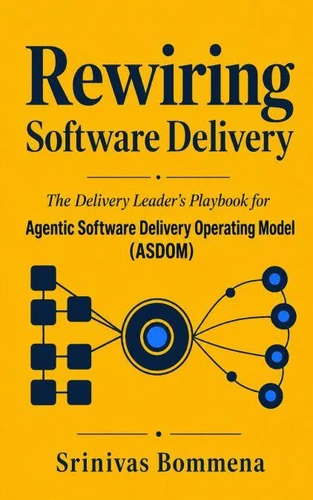
Rewiring Software Delivery for Agentic Software Delivery Operating Model
Par :Formats :
Disponible dans votre compte client Decitre ou Furet du Nord dès validation de votre commande. Le format ePub est :
- Compatible avec une lecture sur My Vivlio (smartphone, tablette, ordinateur)
- Compatible avec une lecture sur liseuses Vivlio
- Pour les liseuses autres que Vivlio, vous devez utiliser le logiciel Adobe Digital Edition. Non compatible avec la lecture sur les liseuses Kindle, Remarkable et Sony
 , qui est-ce ?
Notre partenaire de plateforme de lecture numérique où vous retrouverez l'ensemble de vos ebooks gratuitement
Pour en savoir plus sur nos ebooks, consultez notre aide en ligne ici
C'est si simple ! Lisez votre ebook avec l'app Vivlio sur votre tablette, mobile ou ordinateur :

- FormatePub
- ISBN8235562417
- EAN9798235562417
- Date de parution21/07/2026
- Protection num.pas de protection
- Infos supplémentairesepub
- ÉditeurIoakim Ioakim
Résumé
AI coding tools can generate code, tests and documentation in seconds. Yet many enterprises still struggle with the same ambiguous requirements, review queues, security bottlenecks, release anxiety and fragmented accountability. The problem is not tool adoption. It is the delivery operating model. Rewiring Software Delivery introduces the Agentic Software Delivery Operating Model, or ASDOM: a practical framework for redesigning how strategic intent becomes governed production software.
Instead of inserting agents into an unchanged software development lifecycle, ASDOM separates delivery into three connected layers-Intent, Orchestration and Execution-and defines where human judgement must remain, where agents may act autonomously, what evidence they must produce and how autonomy should expand as organisational trust increases. Written for CIOs, CTOs, engineering leaders, delivery executives, enterprise architects, platform leaders, security leaders and transformation sponsors, the book examines how agentic AI changes the complete delivery system.
It covers intent engineering and executable specifications, architecture as constraint design, human-agent orchestration, planner-executor-validator separation, specification conformance, autonomous deployment, embedded security governance, role redesign, agentic metrics, business-value measurement and transformation readiness. Across 21 chapters and the recurring NovaBuild field narrative, readers learn how to move from isolated productivity experiments to a governed enterprise delivery capability.
The book explains how to establish decision rights, design autonomy boundaries, separate generation from validation, convert exceptions into organisational learning and measure whether AI is genuinely improving the path from business intent to production outcomes. The final section provides a phased roadmap for establishing the foundation, scaling the operating model and institutionalising agentic delivery across the enterprise.
This is not a book about generating more code. It is a leadership playbook for building a delivery system that can move faster while preserving evidence, accountability, security and operational control.
Instead of inserting agents into an unchanged software development lifecycle, ASDOM separates delivery into three connected layers-Intent, Orchestration and Execution-and defines where human judgement must remain, where agents may act autonomously, what evidence they must produce and how autonomy should expand as organisational trust increases. Written for CIOs, CTOs, engineering leaders, delivery executives, enterprise architects, platform leaders, security leaders and transformation sponsors, the book examines how agentic AI changes the complete delivery system.
It covers intent engineering and executable specifications, architecture as constraint design, human-agent orchestration, planner-executor-validator separation, specification conformance, autonomous deployment, embedded security governance, role redesign, agentic metrics, business-value measurement and transformation readiness. Across 21 chapters and the recurring NovaBuild field narrative, readers learn how to move from isolated productivity experiments to a governed enterprise delivery capability.
The book explains how to establish decision rights, design autonomy boundaries, separate generation from validation, convert exceptions into organisational learning and measure whether AI is genuinely improving the path from business intent to production outcomes. The final section provides a phased roadmap for establishing the foundation, scaling the operating model and institutionalising agentic delivery across the enterprise.
This is not a book about generating more code. It is a leadership playbook for building a delivery system that can move faster while preserving evidence, accountability, security and operational control.