Nouveauté
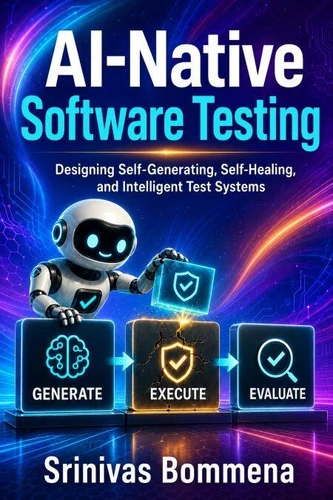
AI-Native Software Testing
Par :Formats :
Disponible dans votre compte client Decitre ou Furet du Nord dès validation de votre commande. Le format ePub est :
- Compatible avec une lecture sur My Vivlio (smartphone, tablette, ordinateur)
- Compatible avec une lecture sur liseuses Vivlio
- Pour les liseuses autres que Vivlio, vous devez utiliser le logiciel Adobe Digital Edition. Non compatible avec la lecture sur les liseuses Kindle, Remarkable et Sony
 , qui est-ce ?
Notre partenaire de plateforme de lecture numérique où vous retrouverez l'ensemble de vos ebooks gratuitement
Pour en savoir plus sur nos ebooks, consultez notre aide en ligne ici
C'est si simple ! Lisez votre ebook avec l'app Vivlio sur votre tablette, mobile ou ordinateur :

- FormatePub
- ISBN8235245624
- EAN9798235245624
- Date de parution21/07/2026
- Protection num.pas de protection
- Infos supplémentairesepub
- ÉditeurIoakim Ioakim
Résumé
Software testing has reached an architectural breaking point. Modern applications change continuously. User interfaces are dynamic, services are distributed, release cycles are compressed, and AI-powered features introduce outputs that cannot always be tested with fixed expected values. Traditional test suites still execute, but brittle locators, noisy failures, excessive retries, weak test oracles, and growing maintenance costs make their results increasingly difficult to trust.
AI-Native Software Testing presents a practical architecture for building intelligent test systems without abandoning deterministic engineering discipline. Rather than treating artificial intelligence as an unrestricted test author, this book shows how to combine Playwright, AI agents, large language models, explicit test oracles, controlled self-healing, evidence-driven failure analysis, and governed automation.
The objective is not merely to generate more tests. It is to create a testing system that can distinguish a broken product from a broken test, explore unknown behaviour, adapt safely to interface changes, and produce evidence that engineering teams can act on. Readers will learn how to:. Build a resilient Playwright execution layer. Design stable locator, authentication, and agent-tool contracts. Generate useful tests from requirements, defects, and product behaviour.
Implement confidence-gated self-healing without hiding regressions. Use autonomous agents for bounded exploratory testing. Apply multimodal AI to visual and responsive testing. Prioritise tests using risk, change, and historical failure signals. Diagnose flakiness and classify failures using structured evidence. Test REST APIs, GraphQL services, contracts, and microservices. Use property-based, metamorphic, and differential testing as stronger AI oracles.
Generate privacy-aware synthetic test data. Apply AI to performance, accessibility, and security testing. Evaluate RAG systems, conversational features, and agentic applications. Govern MCP tools, model context, permissions, cost, and execution limits. Measure whether test agents are reliable enough for production use. Integrate AI-native testing into CI/CD and enterprise assurance processesThe book follows a single commerce-style reference application across 22 chapters.
The system includes authentication, checkout, REST and GraphQL services, dynamic user interfaces, a retrieval-backed assistant, and a production-oriented delivery pipeline. Each chapter adds a concrete capability, control, test asset, or operating decision to that same reference architecture. Hands-on labs, TypeScript and Playwright examples, decision guidance, architecture diagrams, checklists, governance controls, and role-based implementation roadmaps help readers move from isolated AI experiments to a measurable testing capability.
This is not a guide to letting an LLM decide whether software is correct. It is a practitioner's handbook for engineering test systems that use intelligence where adaptation and interpretation add value while preserving deterministic execution, explicit correctness, security, cost control, and human accountability. The manuscript explicitly positions the approach as governed testing with deterministic execution, measurable quality, operational guardrails, and controlled autonomy
AI-Native Software Testing presents a practical architecture for building intelligent test systems without abandoning deterministic engineering discipline. Rather than treating artificial intelligence as an unrestricted test author, this book shows how to combine Playwright, AI agents, large language models, explicit test oracles, controlled self-healing, evidence-driven failure analysis, and governed automation.
The objective is not merely to generate more tests. It is to create a testing system that can distinguish a broken product from a broken test, explore unknown behaviour, adapt safely to interface changes, and produce evidence that engineering teams can act on. Readers will learn how to:. Build a resilient Playwright execution layer. Design stable locator, authentication, and agent-tool contracts. Generate useful tests from requirements, defects, and product behaviour.
Implement confidence-gated self-healing without hiding regressions. Use autonomous agents for bounded exploratory testing. Apply multimodal AI to visual and responsive testing. Prioritise tests using risk, change, and historical failure signals. Diagnose flakiness and classify failures using structured evidence. Test REST APIs, GraphQL services, contracts, and microservices. Use property-based, metamorphic, and differential testing as stronger AI oracles.
Generate privacy-aware synthetic test data. Apply AI to performance, accessibility, and security testing. Evaluate RAG systems, conversational features, and agentic applications. Govern MCP tools, model context, permissions, cost, and execution limits. Measure whether test agents are reliable enough for production use. Integrate AI-native testing into CI/CD and enterprise assurance processesThe book follows a single commerce-style reference application across 22 chapters.
The system includes authentication, checkout, REST and GraphQL services, dynamic user interfaces, a retrieval-backed assistant, and a production-oriented delivery pipeline. Each chapter adds a concrete capability, control, test asset, or operating decision to that same reference architecture. Hands-on labs, TypeScript and Playwright examples, decision guidance, architecture diagrams, checklists, governance controls, and role-based implementation roadmaps help readers move from isolated AI experiments to a measurable testing capability.
This is not a guide to letting an LLM decide whether software is correct. It is a practitioner's handbook for engineering test systems that use intelligence where adaptation and interpretation add value while preserving deterministic execution, explicit correctness, security, cost control, and human accountability. The manuscript explicitly positions the approach as governed testing with deterministic execution, measurable quality, operational guardrails, and controlled autonomy