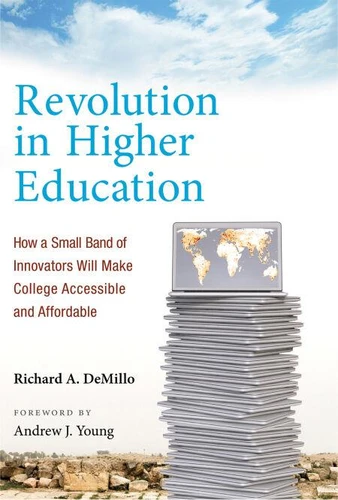
Revolution in Higher Education. How a Small Band of Innovators Will Make College Accessible and Affordable
Par : ,Formats :
Disponible dans votre compte client Decitre ou Furet du Nord dès validation de votre commande. Le format ePub protégé est :
- Compatible avec une lecture sur My Vivlio (smartphone, tablette, ordinateur)
- Compatible avec une lecture sur liseuses Vivlio
- Pour les liseuses autres que Vivlio, vous devez utiliser le logiciel Adobe Digital Edition. Non compatible avec la lecture sur les liseuses Kindle, Remarkable et Sony
- Non compatible avec un achat hors France métropolitaine
 , qui est-ce ?
Notre partenaire de plateforme de lecture numérique où vous retrouverez l'ensemble de vos ebooks gratuitement
Pour en savoir plus sur nos ebooks, consultez notre aide en ligne ici
C'est si simple ! Lisez votre ebook avec l'app Vivlio sur votre tablette, mobile ou ordinateur :

- Nombre de pages360
- FormatePub
- ISBN978-0-262-33129-6
- EAN9780262331296
- Date de parution28/08/2015
- Protection num.Adobe DRM
- Taille3 Mo
- Infos supplémentairesepub
- ÉditeurThe MIT Press
Résumé
A report from the front lines of higher education and technology that chronicles efforts to transform teaching, learning, and opportunity. Colleges and universities have become increasingly costly, and, except for a handful of highly selective, elite institutions, unresponsive to twenty-first-century needs. But for the past few years, technology-fueled innovation has begun to transform higher education, introducing new ways to disseminate knowledge and better ways to learn-all at lower cost.
In this impassioned account, Richard DeMillo tells the behind-the-scenes story of these pioneering efforts and offers a roadmap for transforming higher education. Building on his earlier book, Abelard to Apple, DeMillo argues that the current system of higher education is clearly unsustainable. Colleges and universities are in financial crisis. Tuition rises inexorably. Graduates of reputable schools often fail to learn basic skills, and many cannot find suitable jobs.
Meanwhile, student-loan default rates have soared while the elite Ivy and near-Ivy schools seem remote and irrelevant. Where are the revolutionaries who can save higher education? DeMillo's heroes are a small band of innovators who are bringing the revolution in technology to colleges and universities. DeMillo chronicles, among other things, the invention of MOOCs (Massive Open Online Courses) by professors at Stanford and MIT; Salman Khan's Khan Academy; the use of technology by struggling historically black colleges and universities to make learning more accessible; and the latest research on learning and the brain.
He describes the revolution's goals and the entrenched hierarchical system it aims to overthrow; and he reframes the nature of the contract between society and its universities. The new institutions of a transformed higher education promise to demonstrate not only that education has value but also that it has values-virtues for the common good.
In this impassioned account, Richard DeMillo tells the behind-the-scenes story of these pioneering efforts and offers a roadmap for transforming higher education. Building on his earlier book, Abelard to Apple, DeMillo argues that the current system of higher education is clearly unsustainable. Colleges and universities are in financial crisis. Tuition rises inexorably. Graduates of reputable schools often fail to learn basic skills, and many cannot find suitable jobs.
Meanwhile, student-loan default rates have soared while the elite Ivy and near-Ivy schools seem remote and irrelevant. Where are the revolutionaries who can save higher education? DeMillo's heroes are a small band of innovators who are bringing the revolution in technology to colleges and universities. DeMillo chronicles, among other things, the invention of MOOCs (Massive Open Online Courses) by professors at Stanford and MIT; Salman Khan's Khan Academy; the use of technology by struggling historically black colleges and universities to make learning more accessible; and the latest research on learning and the brain.
He describes the revolution's goals and the entrenched hierarchical system it aims to overthrow; and he reframes the nature of the contract between society and its universities. The new institutions of a transformed higher education promise to demonstrate not only that education has value but also that it has values-virtues for the common good.