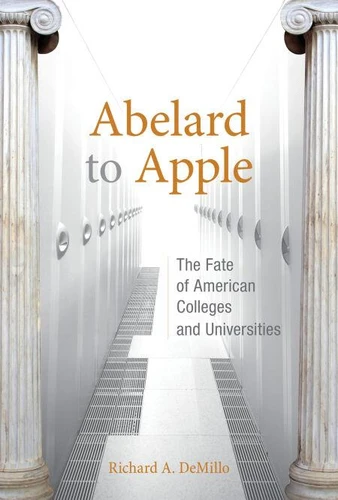
Abelard to Apple. The Fate of American Colleges and Universities
Par :Formats :
Disponible dans votre compte client Decitre ou Furet du Nord dès validation de votre commande. Le format ePub protégé est :
- Compatible avec une lecture sur My Vivlio (smartphone, tablette, ordinateur)
- Compatible avec une lecture sur liseuses Vivlio
- Pour les liseuses autres que Vivlio, vous devez utiliser le logiciel Adobe Digital Edition. Non compatible avec la lecture sur les liseuses Kindle, Remarkable et Sony
- Non compatible avec un achat hors France métropolitaine
 , qui est-ce ?
Notre partenaire de plateforme de lecture numérique où vous retrouverez l'ensemble de vos ebooks gratuitement
Pour en savoir plus sur nos ebooks, consultez notre aide en ligne ici
C'est si simple ! Lisez votre ebook avec l'app Vivlio sur votre tablette, mobile ou ordinateur :

- Nombre de pages344
- FormatePub
- ISBN978-0-262-29761-5
- EAN9780262297615
- Date de parution26/08/2011
- Protection num.Adobe DRM
- Taille793 Ko
- Infos supplémentairesepub
- ÉditeurThe MIT Press
Résumé
How institutions of higher learning can rescue themselves from irrelevance and marginalization in the age of iTunes U and YouTube EDU. The vast majority of American college students attend two thousand or so private and public institutions that might be described as the Middle-reputable educational institutions, but not considered equal to the elite and entrenched upper echelon of the Ivy League and other prestigious schools.
Richard DeMillo has a warning for these colleges and universities in the Middle: If you do not change, you are heading for irrelevance and marginalization. In Abelard to Apple, DeMillo argues that these institutions, clinging precariously to a centuries-old model of higher education, are ignoring the social, historical, and economic forces at work in today's world. In the age of iTunes, open source software, and for-profit online universities, there are new rules for higher education.
DeMillo, who has spent years in both academia and in industry, explains how higher education arrived at its current parlous state and offers a road map for the twenty-first century. He describes the evolving model for higher education, from European universities based on a medieval model to American land-grant colleges to Apple's iTunes U and MIT's OpenCourseWare. He offers ten rules to help colleges reinvent themselves (including "Don't romanticize your weaknesses") and argues for a focus on teaching undergraduates.
DeMillo's message-for colleges and universities, students, alumni, parents, employers, and politicians-is that any college or university can change course if it defines a compelling value proposition (one not based in "institutional envy" of Harvard and Berkeley) and imagines an institution that delivers it.
Richard DeMillo has a warning for these colleges and universities in the Middle: If you do not change, you are heading for irrelevance and marginalization. In Abelard to Apple, DeMillo argues that these institutions, clinging precariously to a centuries-old model of higher education, are ignoring the social, historical, and economic forces at work in today's world. In the age of iTunes, open source software, and for-profit online universities, there are new rules for higher education.
DeMillo, who has spent years in both academia and in industry, explains how higher education arrived at its current parlous state and offers a road map for the twenty-first century. He describes the evolving model for higher education, from European universities based on a medieval model to American land-grant colleges to Apple's iTunes U and MIT's OpenCourseWare. He offers ten rules to help colleges reinvent themselves (including "Don't romanticize your weaknesses") and argues for a focus on teaching undergraduates.
DeMillo's message-for colleges and universities, students, alumni, parents, employers, and politicians-is that any college or university can change course if it defines a compelling value proposition (one not based in "institutional envy" of Harvard and Berkeley) and imagines an institution that delivers it.