
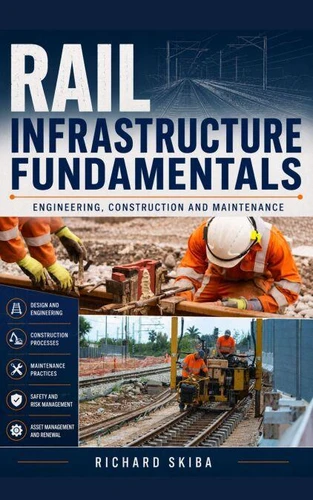
Rail Infrastructure Fundamentals: Engineering, Construction and Maintenance
Par :Formats :
Disponible dans votre compte client Decitre ou Furet du Nord dès validation de votre commande. Le format ePub est :
- Compatible avec une lecture sur My Vivlio (smartphone, tablette, ordinateur)
- Compatible avec une lecture sur liseuses Vivlio
- Pour les liseuses autres que Vivlio, vous devez utiliser le logiciel Adobe Digital Edition. Non compatible avec la lecture sur les liseuses Kindle, Remarkable et Sony
 , qui est-ce ?
Notre partenaire de plateforme de lecture numérique où vous retrouverez l'ensemble de vos ebooks gratuitement
Pour en savoir plus sur nos ebooks, consultez notre aide en ligne ici
C'est si simple ! Lisez votre ebook avec l'app Vivlio sur votre tablette, mobile ou ordinateur :

- FormatePub
- ISBN978-1-7646462-8-4
- EAN9781764646284
- Date de parution03/07/2026
- Protection num.pas de protection
- Infos supplémentairesepub
- ÉditeurRichard Skiba
Résumé
Railways are among the world's most complex, essential, and enduring transportation systems, underpinning economic growth, supporting communities, and enabling the efficient movement of people and freight across vast distances. Behind every railway lies a sophisticated network of infrastructure that must be carefully engineered, constructed, maintained, and managed to ensure safe and reliable operations.
Rail Infrastructure Fundamentals: Engineering, Construction and Maintenance provides a comprehensive introduction to the principles, practices, and technologies that support modern railway infrastructure. Covering the full lifecycle of rail assets, this book explores the engineering, operational, and maintenance disciplines required to design, build, inspect, maintain, and renew railway systems in passenger, freight, heavy-haul, metro, light rail, and tram environments.
Readers are guided through the essential components of railway infrastructure, including track structure, ballast, sleepers, rail systems, turnouts, crossings, signalling interfaces, communications systems, rail corridor assets, utilities, and maintenance equipment. The book examines rail safety, risk management, safeworking practices, quality systems, surveying, track geometry, rail defect detection, non-destructive testing, rail metallurgy, welding, stress management, rail grinding, and modern asset management techniques.
Drawing upon international railway practices and real-world industry examples, the text explains not only how rail infrastructure works, but why specific engineering and maintenance practices are critical to safety, reliability, and performance. Emerging technologies such as automation, predictive maintenance, condition monitoring, digital rail systems, and advanced inspection methods are also explored, providing insight into the future of the railway industry.
Written for rail infrastructure workers, apprentices, trainees, engineers, supervisors, asset managers, vocational and university students, and professionals entering the rail sector, this book serves as both a practical learning resource and a valuable industry reference. Whether you are beginning a career in rail or seeking to deepen your understanding of railway infrastructure, Rail Infrastructure Fundamentals provides the knowledge and foundation needed to succeed in one of the world's most vital and technically demanding industries.
Rail Infrastructure Fundamentals: Engineering, Construction and Maintenance provides a comprehensive introduction to the principles, practices, and technologies that support modern railway infrastructure. Covering the full lifecycle of rail assets, this book explores the engineering, operational, and maintenance disciplines required to design, build, inspect, maintain, and renew railway systems in passenger, freight, heavy-haul, metro, light rail, and tram environments.
Readers are guided through the essential components of railway infrastructure, including track structure, ballast, sleepers, rail systems, turnouts, crossings, signalling interfaces, communications systems, rail corridor assets, utilities, and maintenance equipment. The book examines rail safety, risk management, safeworking practices, quality systems, surveying, track geometry, rail defect detection, non-destructive testing, rail metallurgy, welding, stress management, rail grinding, and modern asset management techniques.
Drawing upon international railway practices and real-world industry examples, the text explains not only how rail infrastructure works, but why specific engineering and maintenance practices are critical to safety, reliability, and performance. Emerging technologies such as automation, predictive maintenance, condition monitoring, digital rail systems, and advanced inspection methods are also explored, providing insight into the future of the railway industry.
Written for rail infrastructure workers, apprentices, trainees, engineers, supervisors, asset managers, vocational and university students, and professionals entering the rail sector, this book serves as both a practical learning resource and a valuable industry reference. Whether you are beginning a career in rail or seeking to deepen your understanding of railway infrastructure, Rail Infrastructure Fundamentals provides the knowledge and foundation needed to succeed in one of the world's most vital and technically demanding industries.
A propos de Richard Skiba



7,49 €


6,99 €

5,99 €

4,99 €




6,49 €


11,99 €

7,49 €
