
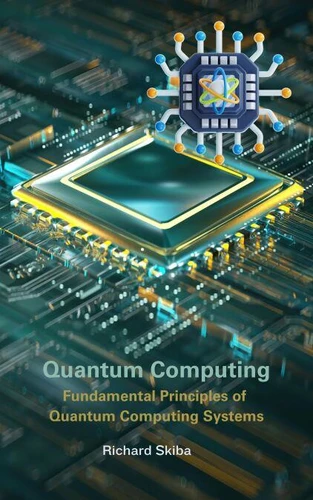
Quantum Computing: Fundamental Principles of Quantum Computing Systems
Par :Formats :
Disponible dans votre compte client Decitre ou Furet du Nord dès validation de votre commande. Le format ePub est :
- Compatible avec une lecture sur My Vivlio (smartphone, tablette, ordinateur)
- Compatible avec une lecture sur liseuses Vivlio
- Pour les liseuses autres que Vivlio, vous devez utiliser le logiciel Adobe Digital Edition. Non compatible avec la lecture sur les liseuses Kindle, Remarkable et Sony
 , qui est-ce ?
Notre partenaire de plateforme de lecture numérique où vous retrouverez l'ensemble de vos ebooks gratuitement
Pour en savoir plus sur nos ebooks, consultez notre aide en ligne ici
C'est si simple ! Lisez votre ebook avec l'app Vivlio sur votre tablette, mobile ou ordinateur :

- FormatePub
- ISBN978-1-7638811-8-1
- EAN9781763881181
- Date de parution09/03/2025
- Protection num.pas de protection
- Infos supplémentairesepub
- ÉditeurRichard Skiba
Résumé
Quantum computing is revolutionizing the way we approach computation, unlocking unprecedented capabilities that challenge the limits of classical computers. This book is a guide for anyone seeking to understand the complexities of this emerging field. Whether you are a student, researcher, or technology enthusiast, this book provides a comprehensive exploration of the core concepts, algorithms, hardware, and real-world applications of quantum computing.
The book begins with a solid introduction to quantum mechanics, the foundational science that makes quantum computing possible. Readers will gain an understanding of key principles such as superposition, entanglement, and quantum interference-phenomena that enable quantum computers to process vast amounts of data in parallel. The discussion then shifts to qubits, the fundamental building blocks of quantum computation, explaining their physical implementations using superconducting circuits, trapped ions, photonic systems, and other technologies.
As the book progresses, it delves into the architecture of quantum computing, covering quantum logic gates, circuit design, and universal gate sets that define how quantum computers perform calculations. It explores groundbreaking quantum algorithms such as Shor's algorithm for factoring large numbers and Grover's algorithm for quantum search, demonstrating how quantum computing achieves exponential speedup over classical methods.
A key challenge in quantum computing is error correction and noise mitigation. This book provides an in-depth analysis of quantum error correction techniques, fault-tolerant computing, and strategies for overcoming decoherence and environmental noise, making it accessible even to readers without a deep background in physics. The discussion extends beyond theory to practical implementations, examining quantum hardware developed by leading technology companies such as IBM, Google, Microsoft, IonQ, and Rigetti.
It also explores the role of quantum computing in cybersecurity, highlighting quantum cryptography, post-quantum encryption, and quantum key distribution protocols that ensure secure communications. The latter sections of the book showcase real-world applications of quantum computing in fields such as artificial intelligence, drug discovery, climate modelling, financial modelling, and supply chain optimization.
It also covers cloud-based quantum computing services like IBM Quantum Experience, Google Quantum AI, and Amazon Braket, providing insights into how organizations can leverage quantum computing without owning expensive quantum hardware. With an eye toward the future, Quantum Computing: Fundamental Principles of Quantum Computing Systems examines the ongoing challenges and expected advancements in the field, offering predictions on the evolution of quantum computing over the next two decades.
This book is an indispensable resource for understanding one of the most exciting technological frontiers of our time.
The book begins with a solid introduction to quantum mechanics, the foundational science that makes quantum computing possible. Readers will gain an understanding of key principles such as superposition, entanglement, and quantum interference-phenomena that enable quantum computers to process vast amounts of data in parallel. The discussion then shifts to qubits, the fundamental building blocks of quantum computation, explaining their physical implementations using superconducting circuits, trapped ions, photonic systems, and other technologies.
As the book progresses, it delves into the architecture of quantum computing, covering quantum logic gates, circuit design, and universal gate sets that define how quantum computers perform calculations. It explores groundbreaking quantum algorithms such as Shor's algorithm for factoring large numbers and Grover's algorithm for quantum search, demonstrating how quantum computing achieves exponential speedup over classical methods.
A key challenge in quantum computing is error correction and noise mitigation. This book provides an in-depth analysis of quantum error correction techniques, fault-tolerant computing, and strategies for overcoming decoherence and environmental noise, making it accessible even to readers without a deep background in physics. The discussion extends beyond theory to practical implementations, examining quantum hardware developed by leading technology companies such as IBM, Google, Microsoft, IonQ, and Rigetti.
It also explores the role of quantum computing in cybersecurity, highlighting quantum cryptography, post-quantum encryption, and quantum key distribution protocols that ensure secure communications. The latter sections of the book showcase real-world applications of quantum computing in fields such as artificial intelligence, drug discovery, climate modelling, financial modelling, and supply chain optimization.
It also covers cloud-based quantum computing services like IBM Quantum Experience, Google Quantum AI, and Amazon Braket, providing insights into how organizations can leverage quantum computing without owning expensive quantum hardware. With an eye toward the future, Quantum Computing: Fundamental Principles of Quantum Computing Systems examines the ongoing challenges and expected advancements in the field, offering predictions on the evolution of quantum computing over the next two decades.
This book is an indispensable resource for understanding one of the most exciting technological frontiers of our time.
A propos de Richard Skiba






7,49 €


6,99 €


5,99 €

4,99 €



6,49 €


11,99 €

7,49 €
