
The author of this volume Dr. Ratan Lal Basu is a Ph. D. in Economics (on Arthasastra, the treatise on political economy and statecraft composed by a Brahma?a scholar Kau?ilya around 300 B. C.). He retired as principal from a Government-Sponsored College at Kolkata, and after retirement got fully occupied with research and publishing activities pertaining to Indology, ancient economics, modern economic problems, economic history, yoga and tantra cult, statecraft, international relations and espionage, ethics and morality and also fiction in English and Bengali (his mother tongue).
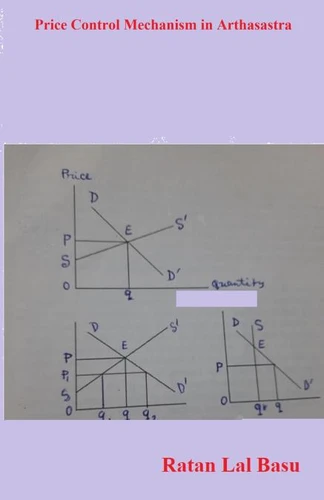
Price Control Mechanism in Arthasastra
Par :Formats :
Disponible dans votre compte client Decitre ou Furet du Nord dès validation de votre commande. Le format ePub est :
- Compatible avec une lecture sur My Vivlio (smartphone, tablette, ordinateur)
- Compatible avec une lecture sur liseuses Vivlio
- Pour les liseuses autres que Vivlio, vous devez utiliser le logiciel Adobe Digital Edition. Non compatible avec la lecture sur les liseuses Kindle, Remarkable et Sony
 , qui est-ce ?
Notre partenaire de plateforme de lecture numérique où vous retrouverez l'ensemble de vos ebooks gratuitement
Pour en savoir plus sur nos ebooks, consultez notre aide en ligne ici
C'est si simple ! Lisez votre ebook avec l'app Vivlio sur votre tablette, mobile ou ordinateur :

- FormatePub
- ISBN8215836699
- EAN9798215836699
- Date de parution22/01/2023
- Protection num.pas de protection
- Infos supplémentairesepub
- ÉditeurWMG Publishing
Résumé
The basic objective of this study is to investigate into the essential features of price control mechanism in Arthasastra of Kau?ilya and its relevance for the Indian economy at present. The pertinent question in this regard has been put forward in the form of the following hypothesis:i) There is a systematic and coherent price control mechanism implicit in Arthasastra of Kau?ilya.ii) In contrast to the price control mechanism in Arthasastra, the 'administered price policy', pursued in India during the plan period, is inconsistent and ad hoc in nature.iii) The method (in modified form), as available in Arthasastra, may be utilized to devise a coherent 'administered price policy' in a democratic set up as in India at present.
A propos de Ratan Lal Basu

Ethics of Kautilya
E-book
3,99 €
Lessons of Panchatantra
E-book
4,99 €
4,99 €

2,99 €

3,99 €
2,99 €

3,49 €
3,99 €
3,99 €

4,99 €

Tantra Cult and Yoga
E-book
4,99 €

3,99 €

4,99 €

3,99 €

The Curse of the Goddess
E-book
2,99 €
4,99 €