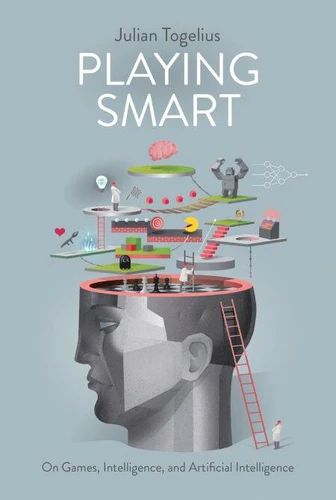
THE FUTURE OF GAME DESIGN IN THE AGE OF AI: Can games measure intelligence? And how will artificial intelligence inform games of the future? In Playing Smart, Julian Togelius explores the connections between games and intelligence to offer a new vision of future games and game design. Video games already depend on AI. We use games to test AI algorithms, challenge our thinking, and better understand both natural and artificial intelligence.
In the future, Togelius argues, game designers will be able to create smarter games that make us smarter in turn, applying advanced AI to help design games. In this book, he tells us how. Games are the past, present, and future of artificial intelligence. In 1948, Alan Turing, one of the founding fathers of computer science and artificial intelligence, handwrote a program for chess. Today we have IBM's Deep Blue and DeepMind's AlphaGo, and huge efforts go into developing AI that can play such arcade games as Pac-Man.
Programmers continue to use games to test and develop AI, creating new benchmarks for AI while also challenging human assumptions and cognitive abilities. Game design is at heart a cognitive science, Togelius reminds us-when we play or design a game, we plan, think spatially, make predictions, move, and assess ourselves and our performance. By studying how we play and design games, Togelius writes, we can better understand how humans and machines think.
AI can do more for game design than providing a skillful opponent. We can harness it to build game-playing and game-designing AI agents, enabling a new generation of AI-augmented games. With AI, we can explore new frontiers in learning and play.
THE FUTURE OF GAME DESIGN IN THE AGE OF AI: Can games measure intelligence? And how will artificial intelligence inform games of the future? In Playing Smart, Julian Togelius explores the connections between games and intelligence to offer a new vision of future games and game design. Video games already depend on AI. We use games to test AI algorithms, challenge our thinking, and better understand both natural and artificial intelligence.
In the future, Togelius argues, game designers will be able to create smarter games that make us smarter in turn, applying advanced AI to help design games. In this book, he tells us how. Games are the past, present, and future of artificial intelligence. In 1948, Alan Turing, one of the founding fathers of computer science and artificial intelligence, handwrote a program for chess. Today we have IBM's Deep Blue and DeepMind's AlphaGo, and huge efforts go into developing AI that can play such arcade games as Pac-Man.
Programmers continue to use games to test and develop AI, creating new benchmarks for AI while also challenging human assumptions and cognitive abilities. Game design is at heart a cognitive science, Togelius reminds us-when we play or design a game, we plan, think spatially, make predictions, move, and assess ourselves and our performance. By studying how we play and design games, Togelius writes, we can better understand how humans and machines think.
AI can do more for game design than providing a skillful opponent. We can harness it to build game-playing and game-designing AI agents, enabling a new generation of AI-augmented games. With AI, we can explore new frontiers in learning and play.

 , qui est-ce ?
