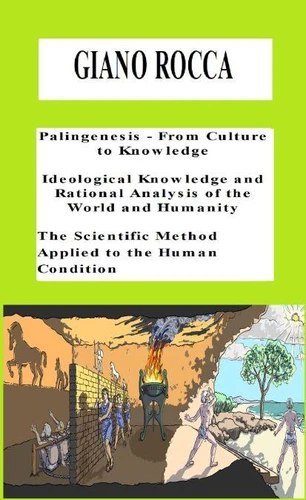



Giano Rocca was born in a small village in the Langhe, called Roccaverano, from parents of humble origins. After completing his primary school studies, he moved to Turin, where he attended secondary school and the University, enrolling in the Faculty of Letters and Philosophy. He was a pupil of the political philosopher Norberto Bobbio. He attended school institutions supporting himself with his work, employed by the large local industry, then called "FIAT".
His interests can be summarized in the study of "social" and "human" sciences, although he soon realized that knowledge in these sectors had not yet reached the episteme of science. He was primarily determined to carry out an analysis of history capable of compensating for the gaps and contradictions of current conceptions and, in particular, of Marxist analysis, whose alleged "scientific essence" has been falsified by the anti-communist revolutions that have occurred in the Soviet Union and in the countries of realized Socialism, especially in Eastern Europe.
The published books aim to provide an overall view of the human condition, with particular attention to the historical reality of societies based on statehood, analyzing them in their structural complexity and their historical dynamics, to identify the possible outcome of human evolution itself. He developed the concept of degrees of civilizing, identifying the fifth level of civilizing in the "closed societies", or feudal ones, while in the "open societies", or mercantile ones, he identified the sixth level of civilizing.
The sixth level of civilizing, however, appears neither irreversible, nor automatically a harbinger of further progress, which progress can only come from a metamorphosis, or palingenesis, of the human condition, which undermines the very presuppositions of organic-stratified societies, of to which the societies based on statehood, as a whole, are but the most advanced examples. To accomplish this palingenesis, neither the "class struggle" nor the social and political revolutions are suitable.
It is necessary to rethink, in depth, the causes of the formation of the historical structural reality and, once the remedies have been identified, apply them to individuals and their inter-personal relationships, a premise for overcoming the conflict between individuality and sociality, defined by philosophers as the great "social problem". It is necessary to lay the foundations for the planning and creation of a sociality cons...
His interests can be summarized in the study of "social" and "human" sciences, although he soon realized that knowledge in these sectors had not yet reached the episteme of science. He was primarily determined to carry out an analysis of history capable of compensating for the gaps and contradictions of current conceptions and, in particular, of Marxist analysis, whose alleged "scientific essence" has been falsified by the anti-communist revolutions that have occurred in the Soviet Union and in the countries of realized Socialism, especially in Eastern Europe.
The published books aim to provide an overall view of the human condition, with particular attention to the historical reality of societies based on statehood, analyzing them in their structural complexity and their historical dynamics, to identify the possible outcome of human evolution itself. He developed the concept of degrees of civilizing, identifying the fifth level of civilizing in the "closed societies", or feudal ones, while in the "open societies", or mercantile ones, he identified the sixth level of civilizing.
The sixth level of civilizing, however, appears neither irreversible, nor automatically a harbinger of further progress, which progress can only come from a metamorphosis, or palingenesis, of the human condition, which undermines the very presuppositions of organic-stratified societies, of to which the societies based on statehood, as a whole, are but the most advanced examples. To accomplish this palingenesis, neither the "class struggle" nor the social and political revolutions are suitable.
It is necessary to rethink, in depth, the causes of the formation of the historical structural reality and, once the remedies have been identified, apply them to individuals and their inter-personal relationships, a premise for overcoming the conflict between individuality and sociality, defined by philosophers as the great "social problem". It is necessary to lay the foundations for the planning and creation of a sociality cons...