Nouveauté
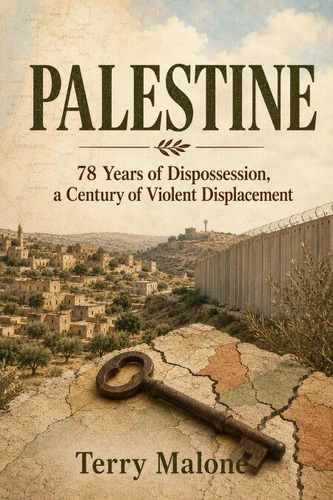
Palestine:78 Years of Dispossession, a Century of Violent Displacement
Par :Formats :
Disponible dans votre compte client Decitre ou Furet du Nord dès validation de votre commande. Le format ePub est :
- Compatible avec une lecture sur My Vivlio (smartphone, tablette, ordinateur)
- Compatible avec une lecture sur liseuses Vivlio
- Pour les liseuses autres que Vivlio, vous devez utiliser le logiciel Adobe Digital Edition. Non compatible avec la lecture sur les liseuses Kindle, Remarkable et Sony
 , qui est-ce ?
Notre partenaire de plateforme de lecture numérique où vous retrouverez l'ensemble de vos ebooks gratuitement
Pour en savoir plus sur nos ebooks, consultez notre aide en ligne ici
C'est si simple ! Lisez votre ebook avec l'app Vivlio sur votre tablette, mobile ou ordinateur :

- FormatePub
- ISBN8235518230
- EAN9798235518230
- Date de parution16/07/2026
- Protection num.pas de protection
- Infos supplémentairesepub
- ÉditeurIoakim Ioakim
Résumé
Palestine did not begin as a refugee camp, a battlefield or a humanitarian crisis. It was a living society of towns, villages, farms and religious communities whose people had deep roots in the land. Palestine: 78 Years of Dispossession, a Century of Violent Displacement traces how that society was dismantled through European political Zionism, British imperial policy, the Nakba of 1948, military occupation, settlement expansion, blockade and repeated war.
Terry Malone challenges the habit of beginning the story with Palestinian resistance while treating occupation and dispossession as background. He examines how wartime displacement became permanent exclusion, how the Oslo process preserved Israeli control beneath the language of peace, and how Gaza became the most extreme expression of a system built upon enclosure, fragmentation and unequal rights.
The destruction that followed 7 October 2023 did not emerge from nowhere. It grew from decades of policies that denied Palestinians sovereignty, freedom of movement, return and political equality. Drawing upon historical scholarship, official records, international law and documented testimony, this book places the present catastrophe within the longer history that made it possible. It distinguishes between established fact, allegation, institutional finding and unresolved legal judgment while refusing to treat unequal power as though it were balanced.
This is not a history of an ancient religious war. It is an account of political decisions, imperial power, organised dispossession and a people's continuing struggle against erasure.
Terry Malone challenges the habit of beginning the story with Palestinian resistance while treating occupation and dispossession as background. He examines how wartime displacement became permanent exclusion, how the Oslo process preserved Israeli control beneath the language of peace, and how Gaza became the most extreme expression of a system built upon enclosure, fragmentation and unequal rights.
The destruction that followed 7 October 2023 did not emerge from nowhere. It grew from decades of policies that denied Palestinians sovereignty, freedom of movement, return and political equality. Drawing upon historical scholarship, official records, international law and documented testimony, this book places the present catastrophe within the longer history that made it possible. It distinguishes between established fact, allegation, institutional finding and unresolved legal judgment while refusing to treat unequal power as though it were balanced.
This is not a history of an ancient religious war. It is an account of political decisions, imperial power, organised dispossession and a people's continuing struggle against erasure.