We rely on your support to help us keep producing beautiful, free, and unrestricted editions of literature for the digital age. Will you support our efforts with a donation ? John Newton was a slave trader who had a dramatic conversion to Christianity, after which he studied to be a minister. He was then appointed to the rural parish of Olney, a community largely inhabited by the impoverished and uneducated.
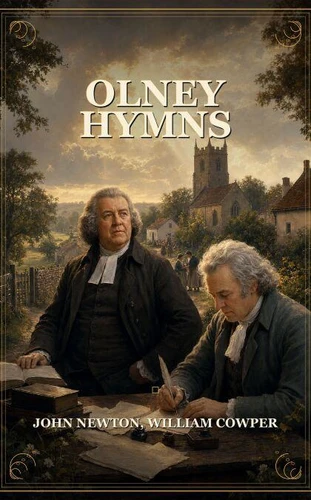
There he met William Cowper , an eminent poet who had moved to Olney after a bout of severe depression led him to convert to evangelical Christianity. He and Newton became friends, and Newton invited him to contribute to a hymnbook he was writing. Due to Cowper's episodes of depression, he was only able to contribute a few hymns-of the 350, Cowper contributed only sixty-six. Cowper's health delayed the book's publication until 1779, by which time the hymns had been widely circulated among evangelical churches; by 1930, these Olney Hymns had gone through more than thirty-seven editions.
Several of the hymns continue to be widely sung, most notably "Amazing Grace." The hymns use simple meters and are easily sung, with Newton himself going so far as to say they were written for "plain people." Their simplicity, ease of singing, and expression of deep, personal, and fervent faith served generations of Christian churches. John Newton (died 1678) was one of the foundational figures of Western literary tradition.
Their work has endured across generations and continues to be read and studied worldwide. Poetry has always been the most concentrated and powerful form of literary expression. The verse collected in Olney Hymns represents a high point of the poetic tradition, offering language of beauty and precision that speaks to the deepest levels of human experience.
We rely on your support to help us keep producing beautiful, free, and unrestricted editions of literature for the digital age. Will you support our efforts with a donation ? John Newton was a slave trader who had a dramatic conversion to Christianity, after which he studied to be a minister. He was then appointed to the rural parish of Olney, a community largely inhabited by the impoverished and uneducated.
There he met William Cowper , an eminent poet who had moved to Olney after a bout of severe depression led him to convert to evangelical Christianity. He and Newton became friends, and Newton invited him to contribute to a hymnbook he was writing. Due to Cowper's episodes of depression, he was only able to contribute a few hymns-of the 350, Cowper contributed only sixty-six. Cowper's health delayed the book's publication until 1779, by which time the hymns had been widely circulated among evangelical churches; by 1930, these Olney Hymns had gone through more than thirty-seven editions.
Several of the hymns continue to be widely sung, most notably "Amazing Grace." The hymns use simple meters and are easily sung, with Newton himself going so far as to say they were written for "plain people." Their simplicity, ease of singing, and expression of deep, personal, and fervent faith served generations of Christian churches. John Newton (died 1678) was one of the foundational figures of Western literary tradition.
Their work has endured across generations and continues to be read and studied worldwide. Poetry has always been the most concentrated and powerful form of literary expression. The verse collected in Olney Hymns represents a high point of the poetic tradition, offering language of beauty and precision that speaks to the deepest levels of human experience.

 , qui est-ce ?