SOLDES
Jusqu'à -70% sur une sélection d'articles*

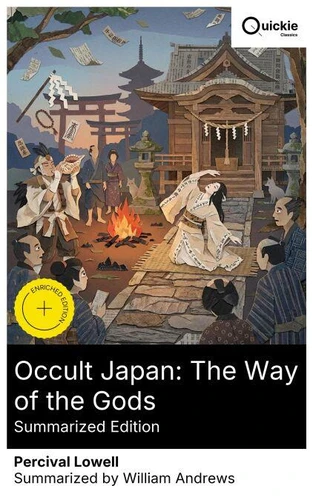
Occult Japan: The Way of the Gods (Summarized Edition). Enriched edition. Spirit possession, oracles, and yamabushi asceticism in Meiji Shinto, amid shinbutsu bunri and tenacious syncretism
Par : ,Formats :
Disponible dans votre compte client Decitre ou Furet du Nord dès validation de votre commande. Le format ePub est :
- Compatible avec une lecture sur My Vivlio (smartphone, tablette, ordinateur)
- Compatible avec une lecture sur liseuses Vivlio
- Pour les liseuses autres que Vivlio, vous devez utiliser le logiciel Adobe Digital Edition. Non compatible avec la lecture sur les liseuses Kindle, Remarkable et Sony
 , qui est-ce ?
Notre partenaire de plateforme de lecture numérique où vous retrouverez l'ensemble de vos ebooks gratuitement
Pour en savoir plus sur nos ebooks, consultez notre aide en ligne ici
C'est si simple ! Lisez votre ebook avec l'app Vivlio sur votre tablette, mobile ou ordinateur :

- Nombre de pages113
- FormatePub
- ISBN859-65--4787717-2
- EAN8596547877172
- Date de parution10/01/2026
- Protection num.Digital Watermarking
- Taille881 Ko
- Infos supplémentairesepub
- ÉditeurQUICKIE CLASSICS
Résumé
Occult Japan: The Way of the Gods probes Shinto as a lived, thaumaturgic tradition. Traveling through late-Meiji villages and shrines, Lowell records god-descents (kamigakari), oracles, fox-possession, exorcisms, fire-walking, yamabushi asceticism, misogi purifications, and matsuri where kami are felt to act. In limpid, essayistic prose that blends travel narrative with proto-ethnography, he situates Shinto amid the recent separation of kami and buddhas (shinbutsu bunri) yet repeatedly finds the tenacious syncretism of practice.
The book preserves minute ritual gestures, tools, and chants otherwise eclipsed by emergent State Shinto. A Boston Brahmin and polymath (1855-1916), Percival Lowell spent formative years in East Asia, learned Japanese, and moved between salons and village precincts. Preceded by The Soul of the Far East and Noto, this inquiry grew from travel notebooks and a Victorian faith in comparative religion.
His later astronomical fame notwithstanding, he writes with an exacting eye for ceremony and speech. Read this as a primary-source portrait of Meiji folk religion-brilliantly observed, though marked by an Orientalist lens. Students of religion, folklore, Japanese studies, and travel writing will find both evidence and style rewarding. Pair it with modern ethnographies to test his claims, and savor the lucid prose. Quickie Classics summarizes timeless works with precision, preserving the author's voice and keeping the prose clear, fast, and readable-distilled, never diluted.
Enriched Edition extras: Introduction · Synopsis · Historical Context · Author Biography · Brief Analysis · 4 Reflection Q&As · Editorial Footnotes.
The book preserves minute ritual gestures, tools, and chants otherwise eclipsed by emergent State Shinto. A Boston Brahmin and polymath (1855-1916), Percival Lowell spent formative years in East Asia, learned Japanese, and moved between salons and village precincts. Preceded by The Soul of the Far East and Noto, this inquiry grew from travel notebooks and a Victorian faith in comparative religion.
His later astronomical fame notwithstanding, he writes with an exacting eye for ceremony and speech. Read this as a primary-source portrait of Meiji folk religion-brilliantly observed, though marked by an Orientalist lens. Students of religion, folklore, Japanese studies, and travel writing will find both evidence and style rewarding. Pair it with modern ethnographies to test his claims, and savor the lucid prose. Quickie Classics summarizes timeless works with precision, preserving the author's voice and keeping the prose clear, fast, and readable-distilled, never diluted.
Enriched Edition extras: Introduction · Synopsis · Historical Context · Author Biography · Brief Analysis · 4 Reflection Q&As · Editorial Footnotes.
A propos de Percival Lowell


1,99 €

0,99 €