SOLDES
Jusqu'à -70% sur une sélection d'articles*

Nouveauté
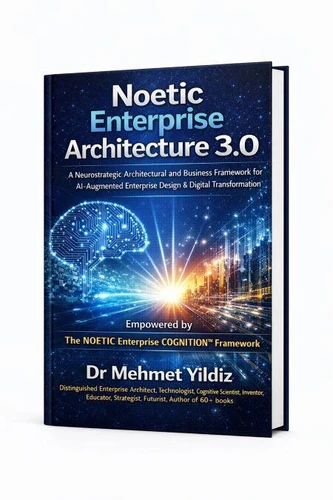
Noetic Enterprise Architecture 3.0 : A Neurostrategic Architectural and Business Framework for AI-Augmented Enterprise Design & Digital Transformation
Par :Formats :
Disponible dans votre compte client Decitre ou Furet du Nord dès validation de votre commande. Le format ePub est :
- Compatible avec une lecture sur My Vivlio (smartphone, tablette, ordinateur)
- Compatible avec une lecture sur liseuses Vivlio
- Pour les liseuses autres que Vivlio, vous devez utiliser le logiciel Adobe Digital Edition. Non compatible avec la lecture sur les liseuses Kindle, Remarkable et Sony
 , qui est-ce ?
Notre partenaire de plateforme de lecture numérique où vous retrouverez l'ensemble de vos ebooks gratuitement
Pour en savoir plus sur nos ebooks, consultez notre aide en ligne ici
C'est si simple ! Lisez votre ebook avec l'app Vivlio sur votre tablette, mobile ou ordinateur :

- FormatePub
- ISBN8233810435
- EAN9798233810435
- Date de parution31/05/2026
- Protection num.pas de protection
- Infos supplémentairesepub
- ÉditeurLinda Balsamo
Résumé
Enterprise Architecture has never been easy for me and others in my circles. Strategies shift, systems accumulate, governance expands. Paradoxically, it becomes increasingly complex as technology advances. Digital transformation promises acceleration, yet complexity grows beneath the surface. Now, artificial intelligence has added another layer of pressure. For example, decisions move faster, automation expands, cloud ecosystems scale globally, regulatory expectations tighten, and boards ask sharper questions.
So, enterprise architects are expected to provide clarity amid it all. As a distinguished enterprise architect, I decided to write Noetic Enterprise Architecture 3.0 in the AI Era because I have lived this complexity and its challenges for decades. It differs from my previous educational books on Enterprise Architecture in that it addresses new challenges. EA 1.0 focused on systems, EA 2.0 institutionalized governance, and EA 3.0 designs intelligence and cognition.
Across global enterprises, large outsourcing programs, transformation initiatives, and executive advisory roles, I have seen architecture succeed and fail. I have seen brilliant AI projects collapse due to weak governance. I have seen well-designed strategies drift because institutional memory was not preserved. I have seen digital acceleration create fragmentation instead of coherence. What we are missing is not more tools.
It is structured institutional cognition. In this new EA book, I introduce my NOETIC Enterprise COGNITIONT Framework, a twelve-node architecture designed to help organizations think coherently in the age of AI. It integrates: Intent Encoding, Capability Coherence, Signal Integrity, Cognitive Risk Mapping, Decision Velocity Calibration, Governance Continuity, Attention Allocation, Institutional Memory Architecture, Adaptive Feedback Loops, Intelligence Stewardship, AI-Human Cognitive Integration, Strategic Clarity Architecture.
These are structural disciplines that, in the long term, make enterprise architecture more flexible and rigorous and simplify digital transformation in the AI era. In this book, I explain:· Why traditional Enterprise Architecture models are no longer sufficient in algorithmic enterprises· How AI changes governance assumptions· How cloud infrastructure becomes cognitive infrastructure· How to align automation authority with accountability· How to measure Cognitive ROI· How to scale transformation without destabilizing operations· How boards, CIOs, CTOs, Enterprise Architects, and Chief Technology Architects can speak a common languageI wrote this book for:· Enterprise Architects, CTOs, CIOs, and executives navigating AI-driven transformation· Chief or Program Architects redesigning governance in complex environments· Business leaders seeking clarity across fragmented portfolios· Boards responsible for overseeing algorithmic risk· SME leaders or startups scaling digital capability without losing coherenceIf you operate in a global enterprise or a growing organization, the structural challenges look similar to me.
Complexity scales differently, but misalignment behaves the same. I offer a disciplined way to design clarity. Enterprise Architecture 3.0 involves institutional intelligence, which I articulate in this book.
So, enterprise architects are expected to provide clarity amid it all. As a distinguished enterprise architect, I decided to write Noetic Enterprise Architecture 3.0 in the AI Era because I have lived this complexity and its challenges for decades. It differs from my previous educational books on Enterprise Architecture in that it addresses new challenges. EA 1.0 focused on systems, EA 2.0 institutionalized governance, and EA 3.0 designs intelligence and cognition.
Across global enterprises, large outsourcing programs, transformation initiatives, and executive advisory roles, I have seen architecture succeed and fail. I have seen brilliant AI projects collapse due to weak governance. I have seen well-designed strategies drift because institutional memory was not preserved. I have seen digital acceleration create fragmentation instead of coherence. What we are missing is not more tools.
It is structured institutional cognition. In this new EA book, I introduce my NOETIC Enterprise COGNITIONT Framework, a twelve-node architecture designed to help organizations think coherently in the age of AI. It integrates: Intent Encoding, Capability Coherence, Signal Integrity, Cognitive Risk Mapping, Decision Velocity Calibration, Governance Continuity, Attention Allocation, Institutional Memory Architecture, Adaptive Feedback Loops, Intelligence Stewardship, AI-Human Cognitive Integration, Strategic Clarity Architecture.
These are structural disciplines that, in the long term, make enterprise architecture more flexible and rigorous and simplify digital transformation in the AI era. In this book, I explain:· Why traditional Enterprise Architecture models are no longer sufficient in algorithmic enterprises· How AI changes governance assumptions· How cloud infrastructure becomes cognitive infrastructure· How to align automation authority with accountability· How to measure Cognitive ROI· How to scale transformation without destabilizing operations· How boards, CIOs, CTOs, Enterprise Architects, and Chief Technology Architects can speak a common languageI wrote this book for:· Enterprise Architects, CTOs, CIOs, and executives navigating AI-driven transformation· Chief or Program Architects redesigning governance in complex environments· Business leaders seeking clarity across fragmented portfolios· Boards responsible for overseeing algorithmic risk· SME leaders or startups scaling digital capability without losing coherenceIf you operate in a global enterprise or a growing organization, the structural challenges look similar to me.
Complexity scales differently, but misalignment behaves the same. I offer a disciplined way to design clarity. Enterprise Architecture 3.0 involves institutional intelligence, which I articulate in this book.
A propos de Dr Mehmet Yildiz



17,49 €



12,99 €