SOLDES
Jusqu'à -70% sur une sélection d'articles*

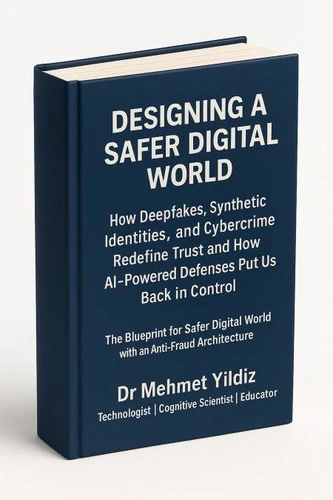
Designing a Safer Digital World: How Deepfakes, Synthetic Identities, and Cybercrime Redefine Trust and How AI-Powered Defences Put Us Back in Control
Par :Formats :
Disponible dans votre compte client Decitre ou Furet du Nord dès validation de votre commande. Le format ePub est :
- Compatible avec une lecture sur My Vivlio (smartphone, tablette, ordinateur)
- Compatible avec une lecture sur liseuses Vivlio
- Pour les liseuses autres que Vivlio, vous devez utiliser le logiciel Adobe Digital Edition. Non compatible avec la lecture sur les liseuses Kindle, Remarkable et Sony
 , qui est-ce ?
Notre partenaire de plateforme de lecture numérique où vous retrouverez l'ensemble de vos ebooks gratuitement
Pour en savoir plus sur nos ebooks, consultez notre aide en ligne ici
C'est si simple ! Lisez votre ebook avec l'app Vivlio sur votre tablette, mobile ou ordinateur :

- FormatePub
- ISBN8232254520
- EAN9798232254520
- Date de parution10/04/2026
- Protection num.pas de protection
- Infos supplémentairesepub
- ÉditeurDraft2Digital
Résumé
Digital fraud is no longer a back-office inconvenience in IT departments. It has become a global emergency affecting governments, businesses, and individuals. Deepfakes, synthetic identities, real-time payment scams, social-engineering kits, and AI-powered crime networks extract billions of dollars from businesses and individuals every year, rapidly eroding confidence in digital systems. The cost is not only financial but also psychological, social, and structural.
When people stop trusting digital services, innovation stops with them. An AI-Powered Fraud Intelligence framework that I developed directly confronts this crisis. Rather than treating fraud as a technical problem or a compliance checkbox, this book reframes it as a strategic threat to digital trust and a defining factor. Drawing on my decades of work in cybersecurity, enterprise architecture, financial and healthcare services consultancy, and support for digital government initiatives, this book explains what leaders urgently need to understand: crime is now automated, global, and learning faster than most institutions.
Through a clear, educational, and narrative-driven style that blends architectural insight with real-world experience, the book shows how organizations can move beyond outdated rule-based defenses and build self-learning fraud-prevention ecosystems that adapt to new attacks as quickly as criminals invent them. You will learn how to design fraud programs that protect revenue rather than restrict it, reduce false positives without increasing risk, and defend customers without compromising usability.
At the heart of the book is the AIFIRET (AI-Powered Fraud Intelligence and Resilience Engine) framework, a practical model for building modern fraud capabilities across identity, behavioral intelligence, transaction monitoring, resilience, and ethical governance. It connects strategy, architecture, operations, technology, and cultural change into a single coherent approach. Unlike highly technical texts aimed solely at data scientists or technologists, this book balances business clarity, architectural frameworks, design excellence, and technical credibility, offering: A breakdown of how sophisticated fraud attacks are structured and scaled The architectural blueprint for modern fraud defenses across industries Guidance on choosing and integrating AI tools and platforms without vendor lock-in Operational best practices for improving accuracy while reducing customer friction Designing KPIs, dashboards, and board-level reporting models that matter A deep but accessible look at the machine-learning approaches that truly work in practice From major banks and fintech leaders to governments, telecom giants, e-commerce platforms, healthcare organizations, and emerging Web3 ecosystems, every digital organization now faces the same reality: trust is everything, and fraud is the fastest way to lose it.
This book delivers the rare combination of strategic foresight, architectural thinking, and practical implementation needed to navigate this high-stakes era and to build systems that protect people, not just prevent losses. This multi-layered work goes beyond stopping fraud. It also covers preserving the integrity of the digital world and ensuring that the next generation of innovation is built on trust, safety, and human confidence, not fear.
I wrote this book for CIOs, CISOs, CTOs, Chief Risk Officers, Chief Compliance Officers, Heads of Fraud & Financial Crime, Government digital identity and security leaders, digital transformation leaders, enterprise architects, security program or project managers, cybersecurity students, early-career practitioners, and anyone who wants to prevent and overcome fraud or scams.
When people stop trusting digital services, innovation stops with them. An AI-Powered Fraud Intelligence framework that I developed directly confronts this crisis. Rather than treating fraud as a technical problem or a compliance checkbox, this book reframes it as a strategic threat to digital trust and a defining factor. Drawing on my decades of work in cybersecurity, enterprise architecture, financial and healthcare services consultancy, and support for digital government initiatives, this book explains what leaders urgently need to understand: crime is now automated, global, and learning faster than most institutions.
Through a clear, educational, and narrative-driven style that blends architectural insight with real-world experience, the book shows how organizations can move beyond outdated rule-based defenses and build self-learning fraud-prevention ecosystems that adapt to new attacks as quickly as criminals invent them. You will learn how to design fraud programs that protect revenue rather than restrict it, reduce false positives without increasing risk, and defend customers without compromising usability.
At the heart of the book is the AIFIRET (AI-Powered Fraud Intelligence and Resilience Engine) framework, a practical model for building modern fraud capabilities across identity, behavioral intelligence, transaction monitoring, resilience, and ethical governance. It connects strategy, architecture, operations, technology, and cultural change into a single coherent approach. Unlike highly technical texts aimed solely at data scientists or technologists, this book balances business clarity, architectural frameworks, design excellence, and technical credibility, offering: A breakdown of how sophisticated fraud attacks are structured and scaled The architectural blueprint for modern fraud defenses across industries Guidance on choosing and integrating AI tools and platforms without vendor lock-in Operational best practices for improving accuracy while reducing customer friction Designing KPIs, dashboards, and board-level reporting models that matter A deep but accessible look at the machine-learning approaches that truly work in practice From major banks and fintech leaders to governments, telecom giants, e-commerce platforms, healthcare organizations, and emerging Web3 ecosystems, every digital organization now faces the same reality: trust is everything, and fraud is the fastest way to lose it.
This book delivers the rare combination of strategic foresight, architectural thinking, and practical implementation needed to navigate this high-stakes era and to build systems that protect people, not just prevent losses. This multi-layered work goes beyond stopping fraud. It also covers preserving the integrity of the digital world and ensuring that the next generation of innovation is built on trust, safety, and human confidence, not fear.
I wrote this book for CIOs, CISOs, CTOs, Chief Risk Officers, Chief Compliance Officers, Heads of Fraud & Financial Crime, Government digital identity and security leaders, digital transformation leaders, enterprise architects, security program or project managers, cybersecurity students, early-career practitioners, and anyone who wants to prevent and overcome fraud or scams.
A propos de Dr Mehmet Yildiz



17,49 €







12,99 €