
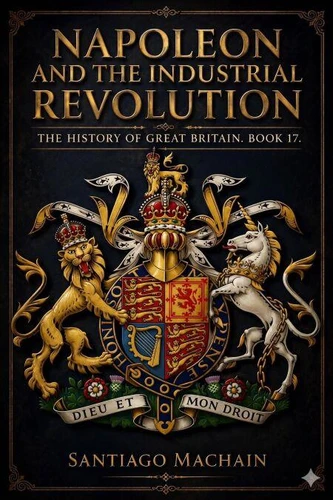
Napoleon and the Industrial Revolution. The History of Great Britain, #17
Par :Formats :
Disponible dans votre compte client Decitre ou Furet du Nord dès validation de votre commande. Le format ePub est :
- Compatible avec une lecture sur My Vivlio (smartphone, tablette, ordinateur)
- Compatible avec une lecture sur liseuses Vivlio
- Pour les liseuses autres que Vivlio, vous devez utiliser le logiciel Adobe Digital Edition. Non compatible avec la lecture sur les liseuses Kindle, Remarkable et Sony
 , qui est-ce ?
Notre partenaire de plateforme de lecture numérique où vous retrouverez l'ensemble de vos ebooks gratuitement
Pour en savoir plus sur nos ebooks, consultez notre aide en ligne ici
C'est si simple ! Lisez votre ebook avec l'app Vivlio sur votre tablette, mobile ou ordinateur :

- FormatePub
- ISBN8235636712
- EAN9798235636712
- Date de parution19/06/2026
- Protection num.pas de protection
- Infos supplémentairesepub
- ÉditeurIoakim Ioakim
Résumé
At the dawn of the nineteenth century, Britain faced two revolutions at once. Across Europe, Napoleon Bonaparte reshaped borders, crushed armies, and threatened the balance of power. At home, factories, coal mines, ironworks, steam engines, and rapidly growing cities were transforming everyday life with equal force. Napoleon and the Industrial Revolution explores how Britain survived the Napoleonic Wars while becoming the world's first industrial nation.
From Horatio Nelson and the Battle of Trafalgar to the Duke of Wellington, the Peninsular War, and the final defeat of Napoleon at Waterloo, the book brings the military struggle to life through its commanders, soldiers, and civilians. Beyond the battlefield, it examines the sweeping changes that reshaped British society: the Agricultural Revolution, the rise of factories, the power of coal and steam, the growth of industrial cities, and the harsh realities of child labor and working-class life.
It concludes with the Reform Act of 1832, a landmark political change that reflected the pressure created by a rapidly modernizing nation.
From Horatio Nelson and the Battle of Trafalgar to the Duke of Wellington, the Peninsular War, and the final defeat of Napoleon at Waterloo, the book brings the military struggle to life through its commanders, soldiers, and civilians. Beyond the battlefield, it examines the sweeping changes that reshaped British society: the Agricultural Revolution, the rise of factories, the power of coal and steam, the growth of industrial cities, and the harsh realities of child labor and working-class life.
It concludes with the Reform Act of 1832, a landmark political change that reflected the pressure created by a rapidly modernizing nation.
A propos de Santiago Machain






7,99 €




7,99 €

7,99 €


7,99 €

7,99 €


6,99 €

7,99 €