
Nouveauté
My Autobiography
Par :Formats :
Disponible dans votre compte client Decitre ou Furet du Nord dès validation de votre commande. Le format ePub est :
- Compatible avec une lecture sur My Vivlio (smartphone, tablette, ordinateur)
- Compatible avec une lecture sur liseuses Vivlio
- Pour les liseuses autres que Vivlio, vous devez utiliser le logiciel Adobe Digital Edition. Non compatible avec la lecture sur les liseuses Kindle, Remarkable et Sony
 , qui est-ce ?
Notre partenaire de plateforme de lecture numérique où vous retrouverez l'ensemble de vos ebooks gratuitement
Pour en savoir plus sur nos ebooks, consultez notre aide en ligne ici
C'est si simple ! Lisez votre ebook avec l'app Vivlio sur votre tablette, mobile ou ordinateur :

- FormatePub
- ISBN8996809219
- EAN9798996809219
- Date de parution24/08/2026
- Protection num.pas de protection
- Infos supplémentairesepub
- ÉditeurKerosene Press
Résumé
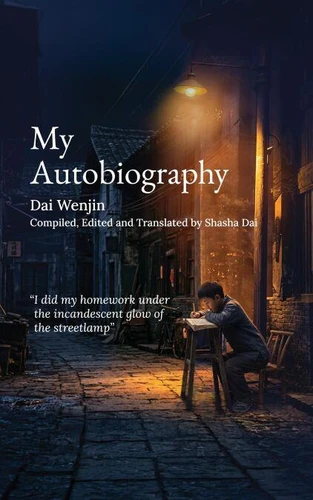
A working-class life. The Cultural Revolution he survived. A story he could never tell at home. A tailor's son does his homework by streetlamp because his family has no electricity. Decades later, that same boy is a dean at a Chinese university, having lived through a factory floor, a broken educational system and one of the most turbulent centuries in his country's history. Dai Wenjin was born in 1948, on the eve of Liberation, into a grassroots tailor's family in Nanchang.
He grew up in a single cramped alleyway home with no desk, no study room and no electric light. He came of age as a factory worker during the Cultural Revolution. Then, through one anomalous opening in a broken system, he was admitted to Tsinghua University, China's most prestigious institution, and went on to a forty-year career as a professor and dean. Western accounts of the Cultural Revolution tend to dwell on singular trauma or the political fall of elites.
This memoir is different. Told with the even-keeled clarity of the professor Dai Wenjin became, it is a rare, unsanitized record of how an ordinary, working-class family navigated the tectonic shifts of mid-century China, neither dramatized nor softened, simply remembered. The book is published in the United States because it cannot be published in China. A private family attempt to translate it was deleted in real time by a Chinese app's censorship filters, silently and without appeal.
This edition exists so that the story survives that silence. Compiled, translated and edited by his elder daughter, Shasha Dai, a former Wall Street Journal reporter, this edition includes 13 archival family photographs and is a distilled, single-sitting account, roughly a 45-minute read. It is both a personal record and a rare firsthand witness to history, offered to readers everywhere who value what it took to write it down at all.
He grew up in a single cramped alleyway home with no desk, no study room and no electric light. He came of age as a factory worker during the Cultural Revolution. Then, through one anomalous opening in a broken system, he was admitted to Tsinghua University, China's most prestigious institution, and went on to a forty-year career as a professor and dean. Western accounts of the Cultural Revolution tend to dwell on singular trauma or the political fall of elites.
This memoir is different. Told with the even-keeled clarity of the professor Dai Wenjin became, it is a rare, unsanitized record of how an ordinary, working-class family navigated the tectonic shifts of mid-century China, neither dramatized nor softened, simply remembered. The book is published in the United States because it cannot be published in China. A private family attempt to translate it was deleted in real time by a Chinese app's censorship filters, silently and without appeal.
This edition exists so that the story survives that silence. Compiled, translated and edited by his elder daughter, Shasha Dai, a former Wall Street Journal reporter, this edition includes 13 archival family photographs and is a distilled, single-sitting account, roughly a 45-minute read. It is both a personal record and a rare firsthand witness to history, offered to readers everywhere who value what it took to write it down at all.