- Accueil /
- Dai Wenjin
Dai Wenjin

Dernière sortie
My Autobiography
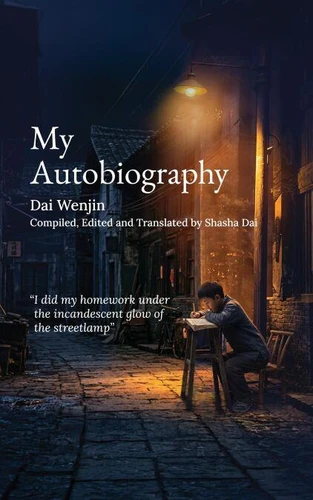
A working-class life. The Cultural Revolution he survived. A story he could never tell at home. A tailor's son does his homework by streetlamp because his family has no electricity. Decades later, that same boy is a dean at a Chinese university, having lived through a factory floor, a broken educational system and one of the most turbulent centuries in his country's history. Dai Wenjin was born in 1948, on the eve of Liberation, into a grassroots tailor's family in Nanchang.
He grew up in a single cramped alleyway home with no desk, no study room and no electric light. He came of age as a factory worker during the Cultural Revolution. Then, through one anomalous opening in a broken system, he was admitted to Tsinghua University, China's most prestigious institution, and went on to a forty-year career as a professor and dean. Western accounts of the Cultural Revolution tend to dwell on singular trauma or the political fall of elites.
This memoir is different. Told with the even-keeled clarity of the professor Dai Wenjin became, it is a rare, unsanitized record of how an ordinary, working-class family navigated the tectonic shifts of mid-century China, neither dramatized nor softened, simply remembered. The book is published in the United States because it cannot be published in China. A private family attempt to translate it was deleted in real time by a Chinese app's censorship filters, silently and without appeal.
This edition exists so that the story survives that silence. Compiled, translated and edited by his elder daughter, Shasha Dai, a former Wall Street Journal reporter, this edition includes 13 archival family photographs and is a distilled, single-sitting account, roughly a 45-minute read. It is both a personal record and a rare firsthand witness to history, offered to readers everywhere who value what it took to write it down at all.
He grew up in a single cramped alleyway home with no desk, no study room and no electric light. He came of age as a factory worker during the Cultural Revolution. Then, through one anomalous opening in a broken system, he was admitted to Tsinghua University, China's most prestigious institution, and went on to a forty-year career as a professor and dean. Western accounts of the Cultural Revolution tend to dwell on singular trauma or the political fall of elites.
This memoir is different. Told with the even-keeled clarity of the professor Dai Wenjin became, it is a rare, unsanitized record of how an ordinary, working-class family navigated the tectonic shifts of mid-century China, neither dramatized nor softened, simply remembered. The book is published in the United States because it cannot be published in China. A private family attempt to translate it was deleted in real time by a Chinese app's censorship filters, silently and without appeal.
This edition exists so that the story survives that silence. Compiled, translated and edited by his elder daughter, Shasha Dai, a former Wall Street Journal reporter, this edition includes 13 archival family photographs and is a distilled, single-sitting account, roughly a 45-minute read. It is both a personal record and a rare firsthand witness to history, offered to readers everywhere who value what it took to write it down at all.
A working-class life. The Cultural Revolution he survived. A story he could never tell at home. A tailor's son does his homework by streetlamp because his family has no electricity. Decades later, that same boy is a dean at a Chinese university, having lived through a factory floor, a broken educational system and one of the most turbulent centuries in his country's history. Dai Wenjin was born in 1948, on the eve of Liberation, into a grassroots tailor's family in Nanchang.
He grew up in a single cramped alleyway home with no desk, no study room and no electric light. He came of age as a factory worker during the Cultural Revolution. Then, through one anomalous opening in a broken system, he was admitted to Tsinghua University, China's most prestigious institution, and went on to a forty-year career as a professor and dean. Western accounts of the Cultural Revolution tend to dwell on singular trauma or the political fall of elites.
This memoir is different. Told with the even-keeled clarity of the professor Dai Wenjin became, it is a rare, unsanitized record of how an ordinary, working-class family navigated the tectonic shifts of mid-century China, neither dramatized nor softened, simply remembered. The book is published in the United States because it cannot be published in China. A private family attempt to translate it was deleted in real time by a Chinese app's censorship filters, silently and without appeal.
This edition exists so that the story survives that silence. Compiled, translated and edited by his elder daughter, Shasha Dai, a former Wall Street Journal reporter, this edition includes 13 archival family photographs and is a distilled, single-sitting account, roughly a 45-minute read. It is both a personal record and a rare firsthand witness to history, offered to readers everywhere who value what it took to write it down at all.
He grew up in a single cramped alleyway home with no desk, no study room and no electric light. He came of age as a factory worker during the Cultural Revolution. Then, through one anomalous opening in a broken system, he was admitted to Tsinghua University, China's most prestigious institution, and went on to a forty-year career as a professor and dean. Western accounts of the Cultural Revolution tend to dwell on singular trauma or the political fall of elites.
This memoir is different. Told with the even-keeled clarity of the professor Dai Wenjin became, it is a rare, unsanitized record of how an ordinary, working-class family navigated the tectonic shifts of mid-century China, neither dramatized nor softened, simply remembered. The book is published in the United States because it cannot be published in China. A private family attempt to translate it was deleted in real time by a Chinese app's censorship filters, silently and without appeal.
This edition exists so that the story survives that silence. Compiled, translated and edited by his elder daughter, Shasha Dai, a former Wall Street Journal reporter, this edition includes 13 archival family photographs and is a distilled, single-sitting account, roughly a 45-minute read. It is both a personal record and a rare firsthand witness to history, offered to readers everywhere who value what it took to write it down at all.
