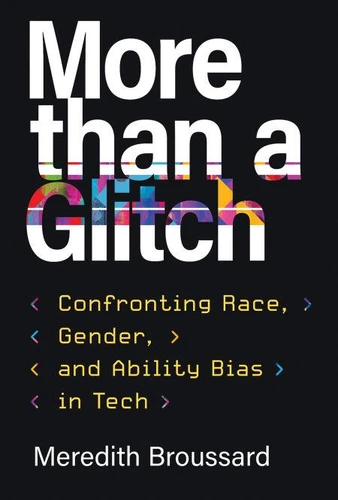
More than a Glitch. Confronting Race, Gender, and Ability Bias in Tech
Par :Formats :
Disponible dans votre compte client Decitre ou Furet du Nord dès validation de votre commande. Le format ePub protégé est :
- Compatible avec une lecture sur My Vivlio (smartphone, tablette, ordinateur)
- Compatible avec une lecture sur liseuses Vivlio
- Pour les liseuses autres que Vivlio, vous devez utiliser le logiciel Adobe Digital Edition. Non compatible avec la lecture sur les liseuses Kindle, Remarkable et Sony
- Non compatible avec un achat hors France métropolitaine
 , qui est-ce ?
Notre partenaire de plateforme de lecture numérique où vous retrouverez l'ensemble de vos ebooks gratuitement
Pour en savoir plus sur nos ebooks, consultez notre aide en ligne ici
C'est si simple ! Lisez votre ebook avec l'app Vivlio sur votre tablette, mobile ou ordinateur :

- Nombre de pages248
- FormatePub
- ISBN978-0-262-37306-7
- EAN9780262373067
- Date de parution14/03/2023
- Protection num.Adobe DRM
- Taille2 Mo
- Infos supplémentairesepub
- ÉditeurThe MIT Press
Résumé
"Broussard, a researcher and reporter whose work focuses on ethics in AI, is the perfect guide to this moment."-GlamourBoth technical and accessible, this intersectional exploration of algorithmic bias offers real solutions for making technology less harmful, from an expert data scientist. The word "glitch" implies an incidental error, as easy to patch up as it is to identify. But what if racism, sexism, and ableism aren't just bugs in mostly functional machinery-what if they're coded into the system itself? In the vein of heavy hitters such as Safiya Umoja Noble, Cathy O'Neil, and Ruha Benjamin, Meredith Broussard demonstrates in More Than a Glitch how neutrality in tech is a myth and why algorithms need to be held accountable.
Broussard, a data scientist and one of the few Black female researchers in artificial intelligence, masterfully synthesizes concepts from computer science and sociology. She explores a range of examples, such as: . Facial recognition technology trained only to recognize lighter skin tones. Mortgage-approval algorithms that encourage discriminatory lending. The dangerous feedback loops that arise when medical diagnostic algorithms are trained on insufficiently diverse data.
How technologies designed with good intentions by fallible humans develop programs that can result in devastating consequencesBroussard argues that the solution isn't to make omnipresent tech more inclusive, but to root out the algorithms that target certain demographics as "other" to begin with. With sweeping implications for fields ranging from jurisprudence to medicine, the ground-breaking insights of More Than a Glitch are essential reading for anyone invested in building a more equitable future.
Broussard, a data scientist and one of the few Black female researchers in artificial intelligence, masterfully synthesizes concepts from computer science and sociology. She explores a range of examples, such as: . Facial recognition technology trained only to recognize lighter skin tones. Mortgage-approval algorithms that encourage discriminatory lending. The dangerous feedback loops that arise when medical diagnostic algorithms are trained on insufficiently diverse data.
How technologies designed with good intentions by fallible humans develop programs that can result in devastating consequencesBroussard argues that the solution isn't to make omnipresent tech more inclusive, but to root out the algorithms that target certain demographics as "other" to begin with. With sweeping implications for fields ranging from jurisprudence to medicine, the ground-breaking insights of More Than a Glitch are essential reading for anyone invested in building a more equitable future.