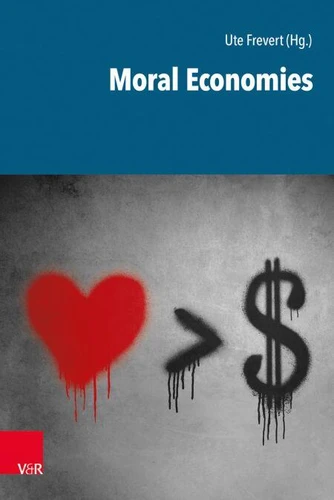
Moral Economies
Par : , , ,Formats :
Disponible dans votre compte client Decitre ou Furet du Nord dès validation de votre commande. Le format PDF est :
- Compatible avec une lecture sur My Vivlio (smartphone, tablette, ordinateur)
- Compatible avec une lecture sur liseuses Vivlio
- Pour les liseuses autres que Vivlio, vous devez utiliser le logiciel Adobe Digital Edition. Non compatible avec la lecture sur les liseuses Kindle, Remarkable et Sony
 , qui est-ce ?
Notre partenaire de plateforme de lecture numérique où vous retrouverez l'ensemble de vos ebooks gratuitement
Pour en savoir plus sur nos ebooks, consultez notre aide en ligne ici
C'est si simple ! Lisez votre ebook avec l'app Vivlio sur votre tablette, mobile ou ordinateur :

- Nombre de pages239
- FormatPDF
- ISBN978-3-647-36426-1
- EAN9783647364261
- Date de parution11/03/2019
- Protection num.pas de protection
- Taille2 Mo
- Infos supplémentairespdf
- ÉditeurVandenhoeck & Ruprecht
Résumé
Is there a moral economy of capitalism? The term "moral economy" was coined in pre-capitalist times and does not refer to economy as we know it today. It was only in the nineteenth century that economy came to mean the production and circulation of goods and services. At the same time, the term started to be used in an explicitly critical tone: references to moral economy were normally critical of modern forms of economy, which were purportedly lacking in morals.
In our times, too, the morality of capitalism is often the topic of debate and controversy. "Moral Economies" engages in these debates. Using historical case studies from the eighteenth, nineteenth, and twentieth centuries the book discusses the degree to which economic actions and decisions were permeated with moral, good-vs-bad classifications. Moreover it shows how strongly antiquity's concept of "embedded" economy is still powerful in modernity.
The model for this was often the private household, in which moral, social, and economic behavior patterns were intertwined. The do-it-yourself movement of the late twentieth and early twenty-first centuries was still oriented towards this model, thereby criticizing capitalism on moral grounds.
In our times, too, the morality of capitalism is often the topic of debate and controversy. "Moral Economies" engages in these debates. Using historical case studies from the eighteenth, nineteenth, and twentieth centuries the book discusses the degree to which economic actions and decisions were permeated with moral, good-vs-bad classifications. Moreover it shows how strongly antiquity's concept of "embedded" economy is still powerful in modernity.
The model for this was often the private household, in which moral, social, and economic behavior patterns were intertwined. The do-it-yourself movement of the late twentieth and early twenty-first centuries was still oriented towards this model, thereby criticizing capitalism on moral grounds.