Micrographia (1665) opens a vast new world by recording, in crystalline prose and sumptuous copperplates, the textures and structures of minute bodies-flea and louse, bee-sting and feather, mold, needle point, and the honeycombed cork in which Hooke first named the 'cells.' Organized as a sequence of observations with reflective 'Inquiries, ' the book marries measurement with speculation, and sets the Baconian ideal of experiment within the visual rhetoric of the Scientific Revolution.
Its dramatic fold-out plates and patient, calibrated descriptions forged a language and iconography for early microscopy. Robert Hooke, polymath Curator of Experiments to the nascent Royal Society and longtime collaborator of Robert Boyle, brought to this work a craftsman's intimacy with instruments and a philosopher's appetite for causes. His refinements in lenses and illumination, his habit of daily experiments, and his duty to stage public demonstrations all fed the project; so too did his draughtsman's hand, which translated observation into authoritative image and argument.
Readers of science, art, and intellectual history will find Micrographia indispensable: a foundational statement of modern empiricism and a gallery of the unseen. Approach it to witness method at work, to savor disciplined wonder, and to grasp how tools and images re-make knowledge.
Quickie Classics summarizes timeless works with precision, preserving the author's voice and keeping the prose clear, fast, and readable-distilled, never diluted.
Enriched Edition extras: Introduction · Synopsis · Historical Context · Author Biography · Brief Analysis · 4 Reflection Q&As · Editorial Footnotes.
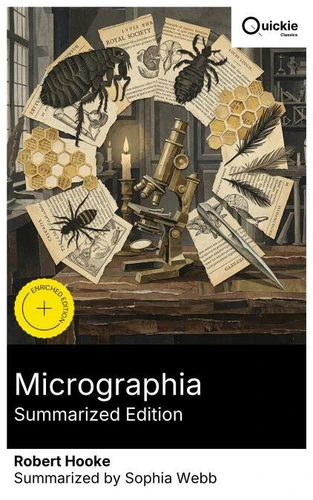
Micrographia (1665) opens a vast new world by recording, in crystalline prose and sumptuous copperplates, the textures and structures of minute bodies-flea and louse, bee-sting and feather, mold, needle point, and the honeycombed cork in which Hooke first named the 'cells.' Organized as a sequence of observations with reflective 'Inquiries, ' the book marries measurement with speculation, and sets the Baconian ideal of experiment within the visual rhetoric of the Scientific Revolution.
Its dramatic fold-out plates and patient, calibrated descriptions forged a language and iconography for early microscopy. Robert Hooke, polymath Curator of Experiments to the nascent Royal Society and longtime collaborator of Robert Boyle, brought to this work a craftsman's intimacy with instruments and a philosopher's appetite for causes. His refinements in lenses and illumination, his habit of daily experiments, and his duty to stage public demonstrations all fed the project; so too did his draughtsman's hand, which translated observation into authoritative image and argument.
Readers of science, art, and intellectual history will find Micrographia indispensable: a foundational statement of modern empiricism and a gallery of the unseen. Approach it to witness method at work, to savor disciplined wonder, and to grasp how tools and images re-make knowledge.
Quickie Classics summarizes timeless works with precision, preserving the author's voice and keeping the prose clear, fast, and readable-distilled, never diluted.
Enriched Edition extras: Introduction · Synopsis · Historical Context · Author Biography · Brief Analysis · 4 Reflection Q&As · Editorial Footnotes.

 , qui est-ce ?