- Accueil /
- Sophia Webb
Sophia Webb

Dernière sortie
An Introduction to the Principles of Morals and Legislation (Summarized Edition)
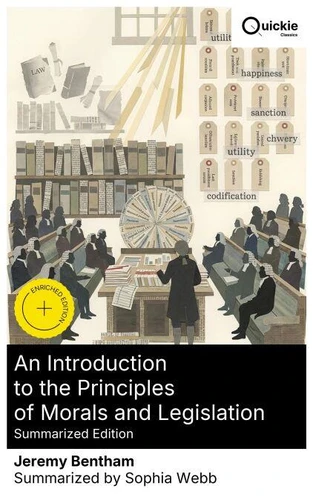
An Introduction to the Principles of Morals and Legislation presents utilitarianism as a practical science of lawmaking. Bentham states the principle of utility, devises the felicific calculus, distinguishes four sanctions, and builds a taxonomy of offenses to guide proportionate punishment. Written in an austere, classificatory style with definitions and careful distinctions, the treatise joins moral theory to jurisprudence.
In the late Enlightenment context, it rejects appeal to custom in favor of transparent calculation and legislative clarity aimed at maximizing collective happiness. Trained in law and called to the bar, Bentham grew impatient with the fictions and inconsistencies of English common law. Influenced by Hume and Helvétius, he pursued codification, proportionate penalties, and administrative transparency.
Encounters with penal abuses and early political economy shaped the book's claim that governance must rest on measurable pleasures and pains rather than tradition or metaphysics. Students of ethics, jurisprudence, public policy, and economics will find a rigorous basis for debates on punishment, welfare, and regulation. Read as both moral philosophy and a manual for legislators, it rewards close study with conceptual economy and practical guidance.
For anyone intent on aligning institutions with human well-being, Bentham's framework remains a bracing, indispensable point of departure. Quickie Classics summarizes timeless works with precision, preserving the author's voice and keeping the prose clear, fast, and readable-distilled, never diluted. Enriched Edition extras: Introduction · Synopsis · Historical Context · Author Biography · Brief Analysis · 4 Reflection Q&As · Editorial Footnotes.
In the late Enlightenment context, it rejects appeal to custom in favor of transparent calculation and legislative clarity aimed at maximizing collective happiness. Trained in law and called to the bar, Bentham grew impatient with the fictions and inconsistencies of English common law. Influenced by Hume and Helvétius, he pursued codification, proportionate penalties, and administrative transparency.
Encounters with penal abuses and early political economy shaped the book's claim that governance must rest on measurable pleasures and pains rather than tradition or metaphysics. Students of ethics, jurisprudence, public policy, and economics will find a rigorous basis for debates on punishment, welfare, and regulation. Read as both moral philosophy and a manual for legislators, it rewards close study with conceptual economy and practical guidance.
For anyone intent on aligning institutions with human well-being, Bentham's framework remains a bracing, indispensable point of departure. Quickie Classics summarizes timeless works with precision, preserving the author's voice and keeping the prose clear, fast, and readable-distilled, never diluted. Enriched Edition extras: Introduction · Synopsis · Historical Context · Author Biography · Brief Analysis · 4 Reflection Q&As · Editorial Footnotes.

An Introduction to the Principles of Morals and Legislation presents utilitarianism as a practical science of lawmaking. Bentham states the principle of utility, devises the felicific calculus, distinguishes four sanctions, and builds a taxonomy of offenses to guide proportionate punishment. Written in an austere, classificatory style with definitions and careful distinctions, the treatise joins moral theory to jurisprudence.
In the late Enlightenment context, it rejects appeal to custom in favor of transparent calculation and legislative clarity aimed at maximizing collective happiness. Trained in law and called to the bar, Bentham grew impatient with the fictions and inconsistencies of English common law. Influenced by Hume and Helvétius, he pursued codification, proportionate penalties, and administrative transparency.
Encounters with penal abuses and early political economy shaped the book's claim that governance must rest on measurable pleasures and pains rather than tradition or metaphysics. Students of ethics, jurisprudence, public policy, and economics will find a rigorous basis for debates on punishment, welfare, and regulation. Read as both moral philosophy and a manual for legislators, it rewards close study with conceptual economy and practical guidance.
For anyone intent on aligning institutions with human well-being, Bentham's framework remains a bracing, indispensable point of departure. Quickie Classics summarizes timeless works with precision, preserving the author's voice and keeping the prose clear, fast, and readable-distilled, never diluted. Enriched Edition extras: Introduction · Synopsis · Historical Context · Author Biography · Brief Analysis · 4 Reflection Q&As · Editorial Footnotes.

In the late Enlightenment context, it rejects appeal to custom in favor of transparent calculation and legislative clarity aimed at maximizing collective happiness. Trained in law and called to the bar, Bentham grew impatient with the fictions and inconsistencies of English common law. Influenced by Hume and Helvétius, he pursued codification, proportionate penalties, and administrative transparency.
Encounters with penal abuses and early political economy shaped the book's claim that governance must rest on measurable pleasures and pains rather than tradition or metaphysics. Students of ethics, jurisprudence, public policy, and economics will find a rigorous basis for debates on punishment, welfare, and regulation. Read as both moral philosophy and a manual for legislators, it rewards close study with conceptual economy and practical guidance.
For anyone intent on aligning institutions with human well-being, Bentham's framework remains a bracing, indispensable point of departure. Quickie Classics summarizes timeless works with precision, preserving the author's voice and keeping the prose clear, fast, and readable-distilled, never diluted. Enriched Edition extras: Introduction · Synopsis · Historical Context · Author Biography · Brief Analysis · 4 Reflection Q&As · Editorial Footnotes.

Les livres de Sophia Webb

Eight Homilies against the Jews (Summarized Edition). Enriched edition. Persuasive 4th-Century Sermons on Christianity and Judaism, Cultural Tensions, and Biblical Polemic
John Chrysostom, Brielle Kestridge, Sophia Webb
E-book
0,99 €


Catherine de Medici (Summarized Edition). Enriched edition. Renaissance-Era French Court Intrigue, 16th‑Century Politics, Romance, and the Wars of Religion
HONORÉ DE BALZAC, Katharine Prescott Wormeley, Kara Brackley, Sophia Webb
E-book
1,99 €


1,99 €