Writes psychologically layered nonfiction about ambition, identity, and emotional resilience with a sharp literary voice.
Nouveauté
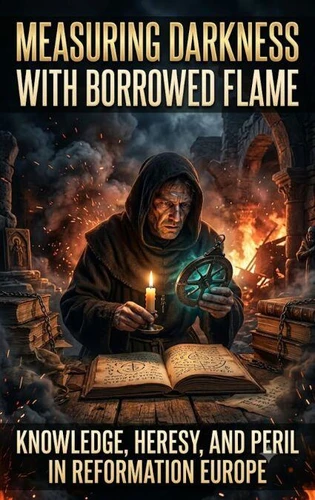
Measuring darkness with borrowed flame. Knowledge, heresy, and peril in Reformation Europe
Par :Formats :
Disponible dans votre compte client Decitre ou Furet du Nord dès validation de votre commande. Le format ePub est :
- Compatible avec une lecture sur My Vivlio (smartphone, tablette, ordinateur)
- Compatible avec une lecture sur liseuses Vivlio
- Pour les liseuses autres que Vivlio, vous devez utiliser le logiciel Adobe Digital Edition. Non compatible avec la lecture sur les liseuses Kindle, Remarkable et Sony
 , qui est-ce ?
Notre partenaire de plateforme de lecture numérique où vous retrouverez l'ensemble de vos ebooks gratuitement
Pour en savoir plus sur nos ebooks, consultez notre aide en ligne ici
C'est si simple ! Lisez votre ebook avec l'app Vivlio sur votre tablette, mobile ou ordinateur :

- Nombre de pages194
- FormatePub
- ISBN978-3-565-54815-6
- EAN9783565548156
- Date de parution08/07/2026
- Protection num.pas de protection
- Taille566 Ko
- Infos supplémentairesepub
- ÉditeurEmphaloz Publishing House
Résumé
Before the telescope could turn toward the moon, someone had to risk their place in the world by saying the moon was not perfect. This book traces the Renaissance scientific revolution not through its celebrated discoveries, but through the fragile human networks that made them possible. In the workshops of Florence, the libraries of Venice, and the courts of Prague, scholars, alchemists, and instrument-makers shared knowledge that could cost them their freedom or their lives.
The period's great intellectual leap-from geocentric cosmology to empirical observation, from Galenic medicine to anatomical dissection-was not a smooth ascent of reason. It was a series of dangerous negotiations between what the church permitted and what the eye could see. Figures like Copernicus, Vesalius, and Kepler did not work in isolation. They depended on patrons who shielded them, printers who risked censure, and correspondents who smuggled manuscripts across borders.
This book reconstructs the clandestine ecology of Renaissance science: the coded letters, the false prefaces, the books published posthumously or abroad. It shows that the scientific method was born not in a laboratory, but in a world where asking the wrong question could mean interrogation, excommunication, or the pyre. The pursuit of knowledge required a kind of courage that is rarely recorded in the footnotes of history.
By following the paths of those who measured, dissected, and observed-often in secret-the book offers a portrait of an era that invented not only new instruments, but new ways of being in the world: skeptical, empirical, and quietly defiant.
The period's great intellectual leap-from geocentric cosmology to empirical observation, from Galenic medicine to anatomical dissection-was not a smooth ascent of reason. It was a series of dangerous negotiations between what the church permitted and what the eye could see. Figures like Copernicus, Vesalius, and Kepler did not work in isolation. They depended on patrons who shielded them, printers who risked censure, and correspondents who smuggled manuscripts across borders.
This book reconstructs the clandestine ecology of Renaissance science: the coded letters, the false prefaces, the books published posthumously or abroad. It shows that the scientific method was born not in a laboratory, but in a world where asking the wrong question could mean interrogation, excommunication, or the pyre. The pursuit of knowledge required a kind of courage that is rarely recorded in the footnotes of history.
By following the paths of those who measured, dissected, and observed-often in secret-the book offers a portrait of an era that invented not only new instruments, but new ways of being in the world: skeptical, empirical, and quietly defiant.