
Lawrence Frederick Peterson Ph. D. is a cognitive psychologist, writer and musician. His books range from self help to color books. Please consider his books for reading and adoption. His latest book is How to Become an Alpha Being, involving personality theory for enhanced self esteem. Enjoy.
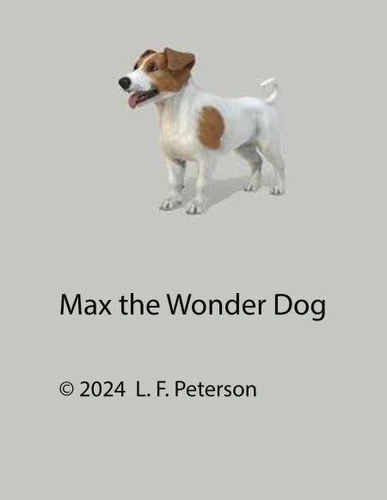
Max the Wonder Dog
Par :Formats :
Disponible dans votre compte client Decitre ou Furet du Nord dès validation de votre commande. Le format ePub est :
- Compatible avec une lecture sur My Vivlio (smartphone, tablette, ordinateur)
- Compatible avec une lecture sur liseuses Vivlio
- Pour les liseuses autres que Vivlio, vous devez utiliser le logiciel Adobe Digital Edition. Non compatible avec la lecture sur les liseuses Kindle, Remarkable et Sony
 , qui est-ce ?
Notre partenaire de plateforme de lecture numérique où vous retrouverez l'ensemble de vos ebooks gratuitement
Pour en savoir plus sur nos ebooks, consultez notre aide en ligne ici
C'est si simple ! Lisez votre ebook avec l'app Vivlio sur votre tablette, mobile ou ordinateur :

- FormatePub
- ISBN8230930310
- EAN9798230930310
- Date de parution25/11/2024
- Protection num.pas de protection
- Infos supplémentairesepub
- ÉditeurIndependently Published
Résumé
L F Peterson's, Max the Wonder Dog (2025) emerges as a compelling addition to the tradition of animal allegories interrogating freedom, community, and humanity's fraught relationship with nature. Drawing inspiration from literary ancestors like Richard Adams' Watership Down and Jack London's wilderness narratives, Peterson crafts a story transcending species to explore universal themes of trauma, liberation, and collective healing.
Yet the novel is no mere retreading of classic tropes. Max revitalizes the genre by centering contemporary anxieties about ecological collapse, institutional exploitation, and the redemptive power of interspecies solidarity. The novel's exploration of captivity and self-determination echoes Orwellian critiques of systemic oppression refracted through the lens of modern animal sanctuary dynamics. Max's journey from kennel prisoner to sanctuary leader parallels the bildungsroman tradition, but with a twist: his growth is measured not by individualism but by his ability to forge alliances across species lines.
This mirrors recent eco-fiction like Charlotte McConaghy's Migrations (2020), where survival hinges on interdependence rather than dominance. Peterson's ghost dog, Red, forms a spectral guardian embodying ecological memory, invoking mythological archetypes, e.g., Cerberus as underworld guide, while subverting them. Red functions less as a traditional spirit guide than as a manifestation of collective trauma and environmental stewardship, a nod to the "haunted landscapes" of Jeff VanderMeer's Southern Reach Trilogy. Where Animal Farm uses barnyard politics to satirize human governance, Max focuses on post-capitalist utopianism.
The sanctuary becomes a microcosm for reimagining community-building, emphasizing interspecies communication and challenging anthropocentric hierarchies. The story critiques perpetual captivity economies, contrasting exploitative kennels with Sarah's trauma-informed refuge, a fictional counterpart to real-world debates about animal rehabilitation. Peterson's prose oscillates between lyrical naturalism and visceral dystopian imagery.
This duality mirrors the tension in Ruth Ozeki's A Tale for the Time Being (2013), where beauty and brutality coexist to mirror planetary crises. The fragmented, sensory-driven chapters evoke Max's fractured psyche while mirroring the nonlinear healing process of trauma survivors.
Yet the novel is no mere retreading of classic tropes. Max revitalizes the genre by centering contemporary anxieties about ecological collapse, institutional exploitation, and the redemptive power of interspecies solidarity. The novel's exploration of captivity and self-determination echoes Orwellian critiques of systemic oppression refracted through the lens of modern animal sanctuary dynamics. Max's journey from kennel prisoner to sanctuary leader parallels the bildungsroman tradition, but with a twist: his growth is measured not by individualism but by his ability to forge alliances across species lines.
This mirrors recent eco-fiction like Charlotte McConaghy's Migrations (2020), where survival hinges on interdependence rather than dominance. Peterson's ghost dog, Red, forms a spectral guardian embodying ecological memory, invoking mythological archetypes, e.g., Cerberus as underworld guide, while subverting them. Red functions less as a traditional spirit guide than as a manifestation of collective trauma and environmental stewardship, a nod to the "haunted landscapes" of Jeff VanderMeer's Southern Reach Trilogy. Where Animal Farm uses barnyard politics to satirize human governance, Max focuses on post-capitalist utopianism.
The sanctuary becomes a microcosm for reimagining community-building, emphasizing interspecies communication and challenging anthropocentric hierarchies. The story critiques perpetual captivity economies, contrasting exploitative kennels with Sarah's trauma-informed refuge, a fictional counterpart to real-world debates about animal rehabilitation. Peterson's prose oscillates between lyrical naturalism and visceral dystopian imagery.
This duality mirrors the tension in Ruth Ozeki's A Tale for the Time Being (2013), where beauty and brutality coexist to mirror planetary crises. The fragmented, sensory-driven chapters evoke Max's fractured psyche while mirroring the nonlinear healing process of trauma survivors.
A propos de Lawrence Peterson

The Quantum Seed
E-book
8,99 €

The Subliminal Mind
E-book
8,99 €

The Amazon Hacker
E-book
8,99 €

Metropolis Revisited
E-book
13,99 €

Sisters of Entanglement
E-book
13,99 €

18,49 €

19,49 €

Sceptre Protocol
E-book
19,49 €

Sly Watchers of Oaxaca
E-book
19,49 €

Secret of Echo Cave
E-book
4,99 €

4,99 €

The Unconscious Saboteur
E-book
4,99 €
