
Dr. Paul Mathews is an anthropologist and sociologist who has worked on Philippine issues for 25 years, and also spent 2 years in Taiwan. He has written extensively about Philippine society and culture in such areas as health, gender relations and sexuality, values, and economic development. He is currently freelancing, following a Research Fellowship at the Australian National University. He is Secretary of the Philippine Studies Association of Australasia, and former Managing Editor of Pilipinas, A Journal of Philippine Studies.
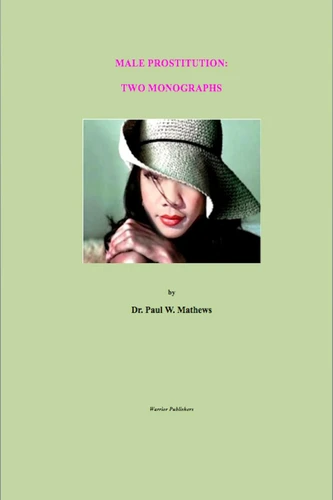
Male Prostitution: Two Monographs
Par :Formats :
Disponible dans votre compte client Decitre ou Furet du Nord dès validation de votre commande. Le format ePub est :
- Compatible avec une lecture sur My Vivlio (smartphone, tablette, ordinateur)
- Compatible avec une lecture sur liseuses Vivlio
- Pour les liseuses autres que Vivlio, vous devez utiliser le logiciel Adobe Digital Edition. Non compatible avec la lecture sur les liseuses Kindle, Remarkable et Sony
 , qui est-ce ?
Notre partenaire de plateforme de lecture numérique où vous retrouverez l'ensemble de vos ebooks gratuitement
Pour en savoir plus sur nos ebooks, consultez notre aide en ligne ici
C'est si simple ! Lisez votre ebook avec l'app Vivlio sur votre tablette, mobile ou ordinateur :

- FormatePub
- ISBN978-1-370-31814-8
- EAN9781370318148
- Date de parution31/08/2016
- Protection num.pas de protection
- Infos supplémentairesepub
- ÉditeurEditeurs divers USA
Résumé
The first paper here describes salient aspects of male prostitution of Ermita (Manila, Philippines) in the 1980s and '90s. I suggest various reasons for such prostitution, how the boys reconcile their activities with church and societal morality, and also how they construct their sexual identity. The second paper is a critique of "Being A Prostitute", in which I argue that certain categories of male prostitutes have been excluded in various studies; these omissions, I suggest, were necessary to allow a hypothesis that most male prostitution derives from economic necessity-a recurrent economic determinism reminiscent of Havelock Ellis, and somewhat contrary to a broader structural approach.
Implicitly at least, in both papers I indicate that boys are willing and able to accommodate a divergent sexual behaviour that does not conflict with their own self-image or the eventual expectations of society: the Western ideological notion that such boys are unwillingly or unwittingly exploited, corrupted and psycho-sexually scarred into becoming adult homosexuals or sex fiends is, I suggest, idiosyncratically Western.
Implicitly at least, in both papers I indicate that boys are willing and able to accommodate a divergent sexual behaviour that does not conflict with their own self-image or the eventual expectations of society: the Western ideological notion that such boys are unwillingly or unwittingly exploited, corrupted and psycho-sexually scarred into becoming adult homosexuals or sex fiends is, I suggest, idiosyncratically Western.
A propos de Paul Mathews

Bankrolling Poverty
E-book
1,99 €
A Virus of Everything
E-book
1,99 €

1,99 €

2,99 €

A Tale of Two Families
E-book
1,99 €

2,99 €

2,99 €


2,99 €


Daze of Our Lives
E-book
1,99 €


1,99 €


1,99 €

My Riddle Book
E-book
0,99 €