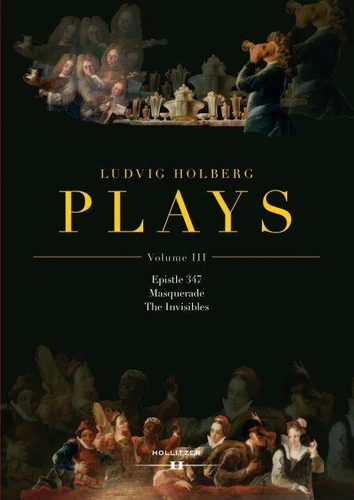
Ludvig Holberg: PLAYS. Volume III: Epistle 347, Masquerade, The Invisibles
Par : ,Formats :
Disponible dans votre compte client Decitre ou Furet du Nord dès validation de votre commande. Le format PDF est :
- Compatible avec une lecture sur My Vivlio (smartphone, tablette, ordinateur)
- Compatible avec une lecture sur liseuses Vivlio
- Pour les liseuses autres que Vivlio, vous devez utiliser le logiciel Adobe Digital Edition. Non compatible avec la lecture sur les liseuses Kindle, Remarkable et Sony
 , qui est-ce ?
Notre partenaire de plateforme de lecture numérique où vous retrouverez l'ensemble de vos ebooks gratuitement
Pour en savoir plus sur nos ebooks, consultez notre aide en ligne ici
C'est si simple ! Lisez votre ebook avec l'app Vivlio sur votre tablette, mobile ou ordinateur :

- Nombre de pages148
- FormatPDF
- ISBN978-3-99094-170-6
- EAN9783990941706
- Date de parution08/09/2023
- Protection num.Digital Watermarking
- Taille905 Ko
- Infos supplémentairespdf
- ÉditeurHollitzer Wissenschaftsverlag
Résumé
Ludvig Holberg (1684-1754) is to Danish theatre what playwrights such as Shakespeare, Molière, Ibsen, Strindberg are to their national stages - and the world stage. During his lifetime, Holberg was a major figure in European literature and thought. In Denmark, his work forms the backdrop to writers such as Søren Kierkegaard, Hans Christian Andersen, Karen Blixen. The quality of Holberg's writing, the universality of his themes, his understanding of stage and auditorium, more than qualify him to resume his place on the international stage.
This third volume in a series of new translations presents Holberg's philosophical essay on the popular (but not with the authorities) masked entertainment of his day, the masquerade.
Two plays then wittily expose and explore subtle negotiations around identity, gender, class, generation, each with particular focus on the mask as means of unmasking codes and conventions. Epistle 347 is a philosophical take on the carnivalesque masquerade as being 'truer' than the social roleplays, under the paradoxical maxim that "strictly speaking we are not truly masked except when bare faced". In the play Masquerade, a patriarchal master of his house sees his hierarchical world order under threat from the young generation - and even his own wife! - enjoying 'useless' masked amusements.
At the other end of the scale, the servant pays no heed to rules and hierarchies. Ultimately, however, they are all but pawns in a game of chance. In the ironic harlequinade The Invisibles, a young gentleman falls in love with an 'invisible' (masked) lady. This noble case of amour causes the servant - Harlequin - to reassess his own wholesome, sensual relationship to his sweetheart - Columbine - and he finds their amour sadly lacking any sophistication.
His ensuing high-flown attempts at imitating aristocratic courtesy cast an ambiguous light on the cultured protocols. It is up to female intelligence to remove the mask from the illusion. "I never tire of reading Holberg's plays." (Henrik Ibsen, 1869)
Two plays then wittily expose and explore subtle negotiations around identity, gender, class, generation, each with particular focus on the mask as means of unmasking codes and conventions. Epistle 347 is a philosophical take on the carnivalesque masquerade as being 'truer' than the social roleplays, under the paradoxical maxim that "strictly speaking we are not truly masked except when bare faced". In the play Masquerade, a patriarchal master of his house sees his hierarchical world order under threat from the young generation - and even his own wife! - enjoying 'useless' masked amusements.
At the other end of the scale, the servant pays no heed to rules and hierarchies. Ultimately, however, they are all but pawns in a game of chance. In the ironic harlequinade The Invisibles, a young gentleman falls in love with an 'invisible' (masked) lady. This noble case of amour causes the servant - Harlequin - to reassess his own wholesome, sensual relationship to his sweetheart - Columbine - and he finds their amour sadly lacking any sophistication.
His ensuing high-flown attempts at imitating aristocratic courtesy cast an ambiguous light on the cultured protocols. It is up to female intelligence to remove the mask from the illusion. "I never tire of reading Holberg's plays." (Henrik Ibsen, 1869)