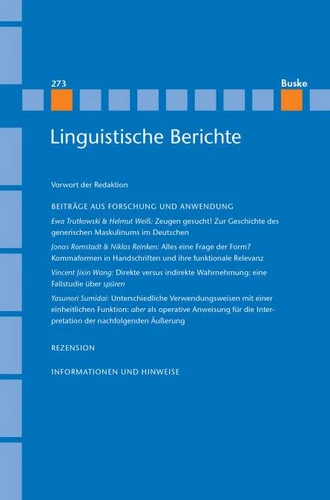
Vorwort der Redaktion
Beiträge aus Forschung und Anwendung
- Ewa Trutkowski & Helmut Weiß: Zeugen gesucht! Zur Geschichte des generischen Maskulinums im Deutschen.
Abstract: On the basis of synchronic and diachronic data, we argue that in the human domain German masculine nouns commonly display a "non-male" generic interpretation which we take as evidence for a separation of syntactic and semantic gender: synchronically, we show that agreement differences between masculine and feminine nouns cannot be traced back to their semantic gender since nouns without sex specification (as e.g.
feminine Person (person) or masculine Mensch (human being)) behave just as differently as nouns with sex specification. In the diachronic part, we prove that the so-called generic masculine is a stable and well-documented phenomenon in the grammatical system of German at least since the Old High German period. To substantiate this claim, we present numerous historical examples for the generic use of masculine nouns such as Gast (guest), Nachbar (neighbour), and Sünder (sinner).
These nouns allow us to look at the particular language use without confounding it with the sociological problem of women's lack of professional integration in the past.
- Jonas Romstadt & Niklas Reinken: Alles eine Frage der Form? Kommaformen in Handschriften und ihre funktionale Relevanz.
Abstract: There are strict formal requirements for the use of a comma. However, there are none regarding the comma's actual shape.
In printed fonts, it is determined by the font's specification. In handwritten texts though, the shape of the comma is variable; most writers choose from a set of straight, convex and concave shapes. By using a corpus of 1464 commas written by 99 individuals, we will present three case studies of persons whose comma shapes do somehow correlate with linguistic structures. With that, we might identify a few (possibly subconscious) shaping strategies.
Some writers might mark a norm insecurity by a different comma form, others might mark the function of the entity which is segmented by the comma, or the comma type itself (sentence boundary, exposition or coordination).
- Vincent Jixin Wang: Direkte versus indirekte Wahrnehmung: eine Fallstudie über spüren.
Abstract: The German perception verb spüren ("feel"), patterning with other perception verbs such as sehen ("see") or hören ("hear"), exhibits various kinds of complement type to be selected.
In this paper, I exploit a type-based compositional semantics in Asher (2011) to account for these cases. I propose a unified lexicon entry for spüren, which captures three essential semantic properties: First, the direct target of spüren are either special tropes (Moltmann, 2007, 2013) which are considered as concrete manifestations of a particular property associated with sensorial stimuli (r-TRO, e.
g., bitterness, warmness), or events which can trigger tactile stimuli (t-EVT, e. g., earthquake, vibration). Second, the process of spüren always depends on the epistemic state of the subject of perception. Third, spüren involves an evidence-relation indicating that its target property should be an accessible evidence for the experiencer's identifying it or inferring something through it. In case of spüren, two kinds of perception should be distinguished: The direct perception based on sensorially triggered evidence, and the indirect perception representing an inference-based and cognitive process.
Formally, the former is reflected in the regular composition, while in the latter case coercion is interpolated.
- Yasunori Sumidai: Unterschiedliche Verwendungsweisen mit einer einheitlichen Funktion: aber als operative Anweisung für die Interpretation der nachfolgenden Äußerung.
Abstract: The conjunction aber (? but) is said to have meanings such as semantic opposition, denial of expectation, or opposite evaluations.
Vorwort der Redaktion
Beiträge aus Forschung und Anwendung
- Ewa Trutkowski & Helmut Weiß: Zeugen gesucht! Zur Geschichte des generischen Maskulinums im Deutschen.
Abstract: On the basis of synchronic and diachronic data, we argue that in the human domain German masculine nouns commonly display a "non-male" generic interpretation which we take as evidence for a separation of syntactic and semantic gender: synchronically, we show that agreement differences between masculine and feminine nouns cannot be traced back to their semantic gender since nouns without sex specification (as e.g.
feminine Person (person) or masculine Mensch (human being)) behave just as differently as nouns with sex specification. In the diachronic part, we prove that the so-called generic masculine is a stable and well-documented phenomenon in the grammatical system of German at least since the Old High German period. To substantiate this claim, we present numerous historical examples for the generic use of masculine nouns such as Gast (guest), Nachbar (neighbour), and Sünder (sinner).
These nouns allow us to look at the particular language use without confounding it with the sociological problem of women's lack of professional integration in the past.
- Jonas Romstadt & Niklas Reinken: Alles eine Frage der Form? Kommaformen in Handschriften und ihre funktionale Relevanz.
Abstract: There are strict formal requirements for the use of a comma. However, there are none regarding the comma's actual shape.
In printed fonts, it is determined by the font's specification. In handwritten texts though, the shape of the comma is variable; most writers choose from a set of straight, convex and concave shapes. By using a corpus of 1464 commas written by 99 individuals, we will present three case studies of persons whose comma shapes do somehow correlate with linguistic structures. With that, we might identify a few (possibly subconscious) shaping strategies.
Some writers might mark a norm insecurity by a different comma form, others might mark the function of the entity which is segmented by the comma, or the comma type itself (sentence boundary, exposition or coordination).
- Vincent Jixin Wang: Direkte versus indirekte Wahrnehmung: eine Fallstudie über spüren.
Abstract: The German perception verb spüren ("feel"), patterning with other perception verbs such as sehen ("see") or hören ("hear"), exhibits various kinds of complement type to be selected.
In this paper, I exploit a type-based compositional semantics in Asher (2011) to account for these cases. I propose a unified lexicon entry for spüren, which captures three essential semantic properties: First, the direct target of spüren are either special tropes (Moltmann, 2007, 2013) which are considered as concrete manifestations of a particular property associated with sensorial stimuli (r-TRO, e.
g., bitterness, warmness), or events which can trigger tactile stimuli (t-EVT, e. g., earthquake, vibration). Second, the process of spüren always depends on the epistemic state of the subject of perception. Third, spüren involves an evidence-relation indicating that its target property should be an accessible evidence for the experiencer's identifying it or inferring something through it. In case of spüren, two kinds of perception should be distinguished: The direct perception based on sensorially triggered evidence, and the indirect perception representing an inference-based and cognitive process.
Formally, the former is reflected in the regular composition, while in the latter case coercion is interpolated.
- Yasunori Sumidai: Unterschiedliche Verwendungsweisen mit einer einheitlichen Funktion: aber als operative Anweisung für die Interpretation der nachfolgenden Äußerung.
Abstract: The conjunction aber (? but) is said to have meanings such as semantic opposition, denial of expectation, or opposite evaluations.