

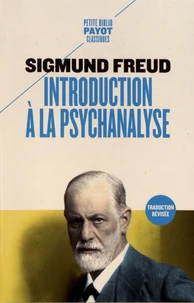
Né le 6 mai 1856 en Autriche et mort le 23 septembre 1939 à Londres, nous connaissons Sigmund Freud pour ses nombreux travaux sur la psychanalyse. Après un diplôme de médecine en 1881, il porte un grand intérêt à la neurologie. En 1885, il étudie à Paris en compagnie du professeur Jean-Martin Charcot, célèbre neurologue français. Intrigué par l'hystérie, son premier cas, à son retour à Vienne, est celui d'une jeune femme : Annah O. C'est cette patiente qui donnera à Freud l'occasion de découvrir les bases de sa pensée : la sexualité et le refoulement. En 1897, il débute ses travaux sur les rêves, le fantasme et le célèbre complexe d'œdipe. En 1920, il met à jour les trois instances de l'appareil psychique : le ça, le moi et le surmoi caractérisant chaque individu. Opposé à la pensée de Carl Gustav Jung, il forme des disciples tout au long de sa vie. Encore aujourd'hui, ses œuvres dont Le Malaise dans la civilisation et Introduction à la psychanalyse sont caractérisées comme des ouvrages fondateurs de la discipline psychanalytique. Apprenez-en plus sur ce sujet passionnant et plongez dans les tréfonds de nos âmes. Parmi les auteurs contemporains fascinés par la psychologie humaine ou s'inspirant de la pensée freudienne, nous vous conseillons Boris Cyrulnik avec Sauve-toi, la vie t'appelle ou Michel Onfray et Traité d'athéologie - Physique de la métaphysique. Disponible en plusieurs formats, profitez de notre garantie satisfait ou remboursé pour vous précipiter dans ces lectures captivantes.
Leonardo da Vinci. A psychosexual study of an infantile reminiscence
Par :Formats :
Disponible dans votre compte client Decitre ou Furet du Nord dès validation de votre commande. Le format ePub est :
- Compatible avec une lecture sur My Vivlio (smartphone, tablette, ordinateur)
- Compatible avec une lecture sur liseuses Vivlio
- Pour les liseuses autres que Vivlio, vous devez utiliser le logiciel Adobe Digital Edition. Non compatible avec la lecture sur les liseuses Kindle, Remarkable et Sony
 , qui est-ce ?
Notre partenaire de plateforme de lecture numérique où vous retrouverez l'ensemble de vos ebooks gratuitement
Pour en savoir plus sur nos ebooks, consultez notre aide en ligne ici
C'est si simple ! Lisez votre ebook avec l'app Vivlio sur votre tablette, mobile ou ordinateur :

- FormatePub
- ISBN978-2-38111-631-0
- EAN9782381116310
- Date de parution09/02/2023
- Protection num.pas de protection
- Infos supplémentairesepub
- ÉditeurEHS
Résumé
When psychoanalytic investigation, which usually contents itself with frail human material, approaches the great personages of humanity, it is not impelled to it by motives which are often attributed to it by laymen. It does not strive "to blacken the radiant and to drag the sublime into the mire"; it finds no satisfaction in diminishing the distance between the perfection of the great and the inadequacy of the ordinary objects.
Leonardo da Vinci was admired even by his contemporaries as one of the greatest men of the Italian Renaissance, still even then he appeared as mysterious to them as he now appears to us. An all-sided genius, "whose form can only be divined but never deeply fathomed, " he exerted the most decisive influence on his time as an artist; and it remained to us to recognize his greatness as a naturalist which was united in him with the artist.
Although he left masterpieces of the art of painting, while his scientific discoveries remained unpublished and unused, the investigator in him has never quite left the artist, often it has severely injured the artist and in the end it has perhaps suppressed the artist altogether. According to Vasari, Leonardo reproached himself during the last hour of his life for having insulted God and men because he has not done his duty to his art.
And even if Vasari's story lacks all probability and belongs to those legends which began to be woven about the mystic master while he was still living, it nevertheless retains indisputable value as a testimonial of the judgment of those people and of those times. What was it that removed the personality of Leonardo from the understanding of his contemporaries?ABOUT THE AUTHOR Sigmund Freud (1856-1939) was an Austrian neurologist and the founder of psychoanalysis, a clinical method for treating psychopathology through dialogue between a patient and a psychoanalyst.
Leonardo da Vinci was admired even by his contemporaries as one of the greatest men of the Italian Renaissance, still even then he appeared as mysterious to them as he now appears to us. An all-sided genius, "whose form can only be divined but never deeply fathomed, " he exerted the most decisive influence on his time as an artist; and it remained to us to recognize his greatness as a naturalist which was united in him with the artist.
Although he left masterpieces of the art of painting, while his scientific discoveries remained unpublished and unused, the investigator in him has never quite left the artist, often it has severely injured the artist and in the end it has perhaps suppressed the artist altogether. According to Vasari, Leonardo reproached himself during the last hour of his life for having insulted God and men because he has not done his duty to his art.
And even if Vasari's story lacks all probability and belongs to those legends which began to be woven about the mystic master while he was still living, it nevertheless retains indisputable value as a testimonial of the judgment of those people and of those times. What was it that removed the personality of Leonardo from the understanding of his contemporaries?ABOUT THE AUTHOR Sigmund Freud (1856-1939) was an Austrian neurologist and the founder of psychoanalysis, a clinical method for treating psychopathology through dialogue between a patient and a psychoanalyst.
A propos de Sigmund Freud
5/5
4/5
10,00 €


3,87 €
3.3/5
3,87 €
4,62 €
3,87 €
3,87 €