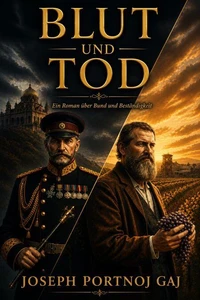
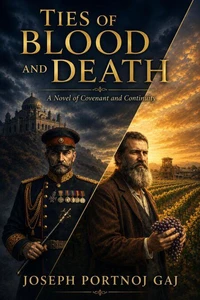
Ties of Blood and Death is a historical novel about what remains when everything else collapses. Empires fall. Borders shift. Ideologies rise and disappear. But survival is not enough. The real question is what can be built after survival-and what it costs to hold it. From the final years of Imperial Russia to the early formation of Israel, the novel follows Leonid-who becomes Aryeh-and the generations shaped by his choices.
He does not seek power. He does not pursue glory. What he accepts instead is far more demanding: responsibility, restraint, and the burden of a word that cannot be taken back. War surrounds him. Exile defines the landscape. Violence is never far. But this is not a story driven by battle. It is driven by decisions. To remain when leaving would be easier. To build when destruction is faster. To hold a structure when everything pressures it to break.
At the center of the novel stands the vineyard-land that does not respond to ambition, only to discipline. It becomes the measure of everything: patience, loss, continuity, and control. It does not reward emotion. It answers only to consistency. Generations pass through it. Some carry forward what was built. Others are tested by it. But the structure holds-not because it is protected, but because it is chosen again and again.
This is not a story about heroes. It is a story about men and women who do not abandon what they have committed to, even when it costs them. Written in a precise and restrained voice, the novel strips away excess and focuses on what endures: identity that is chosen, not inherited; legacy that is built, not claimed; and permanence that must be maintained, not assumed. Ties of Blood and Death is not about victory.
It is about endurance. A novel of covenant and permanence.
Ties of Blood and Death is a historical novel about what remains when everything else collapses. Empires fall. Borders shift. Ideologies rise and disappear. But survival is not enough. The real question is what can be built after survival-and what it costs to hold it. From the final years of Imperial Russia to the early formation of Israel, the novel follows Leonid-who becomes Aryeh-and the generations shaped by his choices.
He does not seek power. He does not pursue glory. What he accepts instead is far more demanding: responsibility, restraint, and the burden of a word that cannot be taken back. War surrounds him. Exile defines the landscape. Violence is never far. But this is not a story driven by battle. It is driven by decisions. To remain when leaving would be easier. To build when destruction is faster. To hold a structure when everything pressures it to break.
At the center of the novel stands the vineyard-land that does not respond to ambition, only to discipline. It becomes the measure of everything: patience, loss, continuity, and control. It does not reward emotion. It answers only to consistency. Generations pass through it. Some carry forward what was built. Others are tested by it. But the structure holds-not because it is protected, but because it is chosen again and again.
This is not a story about heroes. It is a story about men and women who do not abandon what they have committed to, even when it costs them. Written in a precise and restrained voice, the novel strips away excess and focuses on what endures: identity that is chosen, not inherited; legacy that is built, not claimed; and permanence that must be maintained, not assumed. Ties of Blood and Death is not about victory.
It is about endurance. A novel of covenant and permanence.

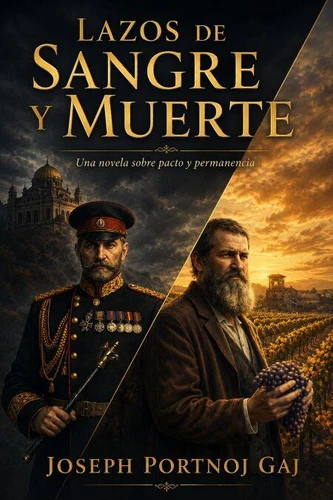
 , qui est-ce ?