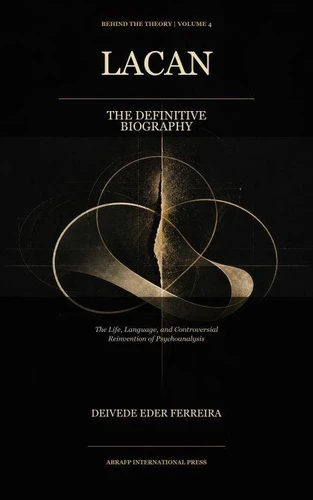
Why does the self first arrive as an image? What does it mean to say that the unconscious is structured like a language? Why did a disagreement over the length of an analytic session reshape institutions on two continents?Lacan - The Definitive Biography tells the story of Jacques Lacan as a life lived through these questions. Trained in psychiatry, formed among Parisian modernists, and sharpened by Freud, Hegel, linguistics, anthropology, logic, and topology, Lacan became the most influential and controversial psychoanalytic teacher after Freud.
Deivede Eder Ferreira reconstructs the decisive crossings between biography and theory: the 1932 thesis on paranoia; the mirror stage; the postwar return to Freud; the 1953 and 1963 ruptures; the creation and dissolution of Lacan's school; the cultural sensation of Écrits; and the late experiments with mathemes, sexuation, Borromean knots, Joyce, and the sinthome. Written for curious general readers, students, clinicians, and scholars, the book also confronts the central disputes around Lacan: variable-length sessions, charismatic authority, institutional power, gender, sexuality, clinical evidence, obscurity, and the posthumous editing of an oral teaching.
Clear without becoming reductive, critical without becoming dismissive, this is an accessible guide to the man, the movement, and the unfinished argument called Lacan.
Why does the self first arrive as an image? What does it mean to say that the unconscious is structured like a language? Why did a disagreement over the length of an analytic session reshape institutions on two continents?Lacan - The Definitive Biography tells the story of Jacques Lacan as a life lived through these questions. Trained in psychiatry, formed among Parisian modernists, and sharpened by Freud, Hegel, linguistics, anthropology, logic, and topology, Lacan became the most influential and controversial psychoanalytic teacher after Freud.
Deivede Eder Ferreira reconstructs the decisive crossings between biography and theory: the 1932 thesis on paranoia; the mirror stage; the postwar return to Freud; the 1953 and 1963 ruptures; the creation and dissolution of Lacan's school; the cultural sensation of Écrits; and the late experiments with mathemes, sexuation, Borromean knots, Joyce, and the sinthome. Written for curious general readers, students, clinicians, and scholars, the book also confronts the central disputes around Lacan: variable-length sessions, charismatic authority, institutional power, gender, sexuality, clinical evidence, obscurity, and the posthumous editing of an oral teaching.
Clear without becoming reductive, critical without becoming dismissive, this is an accessible guide to the man, the movement, and the unfinished argument called Lacan.