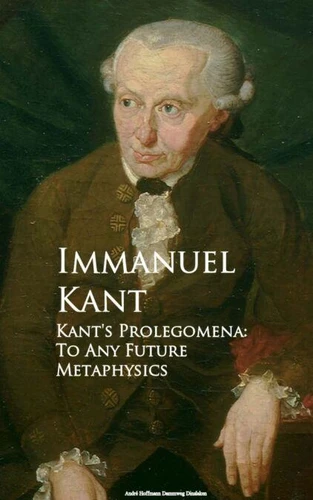
Kant's Prolegomena. To Any Future Metaphysics
Par :Formats :
Disponible dans votre compte client Decitre ou Furet du Nord dès validation de votre commande. Le format ePub est :
- Compatible avec une lecture sur My Vivlio (smartphone, tablette, ordinateur)
- Compatible avec une lecture sur liseuses Vivlio
- Pour les liseuses autres que Vivlio, vous devez utiliser le logiciel Adobe Digital Edition. Non compatible avec la lecture sur les liseuses Kindle, Remarkable et Sony
 , qui est-ce ?
Notre partenaire de plateforme de lecture numérique où vous retrouverez l'ensemble de vos ebooks gratuitement
Pour en savoir plus sur nos ebooks, consultez notre aide en ligne ici
C'est si simple ! Lisez votre ebook avec l'app Vivlio sur votre tablette, mobile ou ordinateur :

- Nombre de pages295
- FormatePub
- ISBN978-3-7364-1598-0
- EAN9783736415980
- Date de parution26/09/2016
- Protection num.Digital Watermarking
- Taille265 Ko
- Infos supplémentairesepub
- ÉditeurAndhof
Résumé
KANT'S Prolegomena, although a small book, is indubitably the most important of his writings. It furnishes us with a key to his main work, The Critique of Pure Reason; in fact, it is an extract containing all the salient ideas of Kant's system. It approaches the subject in the simplest and most direct way, and is therefore best adapted as an introduction into his philosophy. For this reason, The Open Court Publishing Company has deemed it advisable to bring out a new edition of the work, keeping in view its broader use as a preliminary survey and explanation of Kant's philosophy in general.
In order to make the book useful for this broader purpose, the editor has not only stated his own views concerning the problem underlying the Prolegomena, but has also collected the most important materials which have reference to Kant's philosophy, or to the reception which was accorded to it in various quarters. The selections have not been made from a partisan standpoint, but have been chosen with a view to characterising the attitude of different minds, and to directing the student to the best literature on the subject. It is not without good reasons that the appearance of the Critique of Pure Reason is regarded as the beginning of a new era in the history of philosophy; and so it seems that a comprehension of Kant's position, whether we accept or reject it, is indispensable to the student of philosophy.
It is not his solution which makes the sage of Königsberg the initiator of modern thought, but his formulation of the problem. The present translation is practically new, but it goes without saying that the editor utilised the labors of his predecessors, among whom Prof. John P. Mahaffy and John H. Bernard deserve special credit. Richardson's translation of 1818 may be regarded as superseded and has not been consulted, but occasional reference has been made to that of Prof.
Ernest Belfort Bax.
In order to make the book useful for this broader purpose, the editor has not only stated his own views concerning the problem underlying the Prolegomena, but has also collected the most important materials which have reference to Kant's philosophy, or to the reception which was accorded to it in various quarters. The selections have not been made from a partisan standpoint, but have been chosen with a view to characterising the attitude of different minds, and to directing the student to the best literature on the subject. It is not without good reasons that the appearance of the Critique of Pure Reason is regarded as the beginning of a new era in the history of philosophy; and so it seems that a comprehension of Kant's position, whether we accept or reject it, is indispensable to the student of philosophy.
It is not his solution which makes the sage of Königsberg the initiator of modern thought, but his formulation of the problem. The present translation is practically new, but it goes without saying that the editor utilised the labors of his predecessors, among whom Prof. John P. Mahaffy and John H. Bernard deserve special credit. Richardson's translation of 1818 may be regarded as superseded and has not been consulted, but occasional reference has been made to that of Prof.
Ernest Belfort Bax.