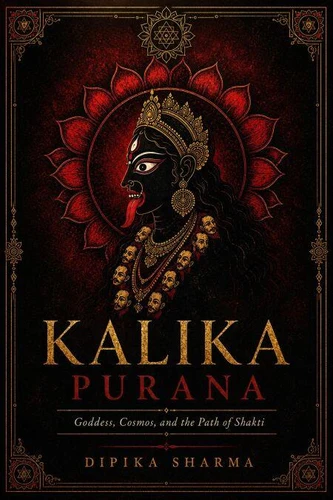
Among the eighteen canonical Puranas and their Upa-Purana counterparts, the Kalika Purana stands apart, fierce, unconventional, and unapologetically rooted in the worship of the Goddess in her most primal forms. Composed in the sacred landscape of Kamakhya in ancient Assam and preserved across centuries in temple traditions that continue to pulse with living devotion, the Kalika Purana is one of the most significant texts of the Shakta tradition and one of the least accessible to English readers.
Until now. In Kalika Purana: Goddess, Cosmos, and the Path of Shakti, scholar and writer Dipika Sharma brings this extraordinary text into the light for the first time in a form designed for the modern English reader. Drawing on Sanskrit primary sources, regional commentaries, oral traditions of the Kamakhya Pitha, and the best of contemporary Indological scholarship, Sharma offers a comprehensive, thematic exploration of the Purana's world, its cosmology, theology, ritual prescriptions, sacred geography, mythological narratives, and Tantric dimensions.
The book moves across nine carefully structured chapters, each illuminating a different facet of the Purana's rich and complex vision. From the text's origins and place in the Puranic canon, to its extraordinary cosmology in which the Goddess is the operative force behind all creation, to the fierce theology of Kali in her multiple forms, to the sacred geography of the Shakti Pithas and the body of the dismembered Sati whose fall to earth created the sacred landscape of the subcontinent, every chapter opens a door into a world that is simultaneously ancient and urgently alive.
Sharma addresses some of the most challenging and often misunderstood aspects of the tradition with scholarly care: the logic of blood sacrifice, the Tantric dimensions of the text, the left-hand path's place within a coherent theological framework, and the living festivals at Kamakhya that continue to draw hundreds of thousands of pilgrims every year. The result is a book that neither romanticizes the tradition nor reduces it to anthropological curiosity, but reads it on its own terms, with the respect that serious scholarship demands.
Written in a style that is at once academically rigorous and humanly accessible, Kalika Purana: Goddess, Cosmos, and the Path of Shakti is the definitive English-language introduction to a text that has shaped the spiritual and cultural landscape of northeastern India for over a millennium. For students of Hindu religion, scholars of South Asian studies, practitioners of Shakta and Tantric traditions, and general readers drawn to the inexhaustible power of the divine feminine, this book is an essential and illuminating guide.
Among the eighteen canonical Puranas and their Upa-Purana counterparts, the Kalika Purana stands apart, fierce, unconventional, and unapologetically rooted in the worship of the Goddess in her most primal forms. Composed in the sacred landscape of Kamakhya in ancient Assam and preserved across centuries in temple traditions that continue to pulse with living devotion, the Kalika Purana is one of the most significant texts of the Shakta tradition and one of the least accessible to English readers.
Until now. In Kalika Purana: Goddess, Cosmos, and the Path of Shakti, scholar and writer Dipika Sharma brings this extraordinary text into the light for the first time in a form designed for the modern English reader. Drawing on Sanskrit primary sources, regional commentaries, oral traditions of the Kamakhya Pitha, and the best of contemporary Indological scholarship, Sharma offers a comprehensive, thematic exploration of the Purana's world, its cosmology, theology, ritual prescriptions, sacred geography, mythological narratives, and Tantric dimensions.
The book moves across nine carefully structured chapters, each illuminating a different facet of the Purana's rich and complex vision. From the text's origins and place in the Puranic canon, to its extraordinary cosmology in which the Goddess is the operative force behind all creation, to the fierce theology of Kali in her multiple forms, to the sacred geography of the Shakti Pithas and the body of the dismembered Sati whose fall to earth created the sacred landscape of the subcontinent, every chapter opens a door into a world that is simultaneously ancient and urgently alive.
Sharma addresses some of the most challenging and often misunderstood aspects of the tradition with scholarly care: the logic of blood sacrifice, the Tantric dimensions of the text, the left-hand path's place within a coherent theological framework, and the living festivals at Kamakhya that continue to draw hundreds of thousands of pilgrims every year. The result is a book that neither romanticizes the tradition nor reduces it to anthropological curiosity, but reads it on its own terms, with the respect that serious scholarship demands.
Written in a style that is at once academically rigorous and humanly accessible, Kalika Purana: Goddess, Cosmos, and the Path of Shakti is the definitive English-language introduction to a text that has shaped the spiritual and cultural landscape of northeastern India for over a millennium. For students of Hindu religion, scholars of South Asian studies, practitioners of Shakta and Tantric traditions, and general readers drawn to the inexhaustible power of the divine feminine, this book is an essential and illuminating guide.


 , qui est-ce ?