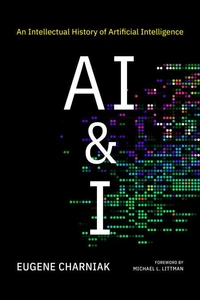
Professeur d'informatique et de sciences cognitives à l'Université Brown (à Providence, Rhode Island). Il est titulaire d'un doctorat en informatique au M. I. T. Son domaine de recherche est la compréhension des langages naturels.
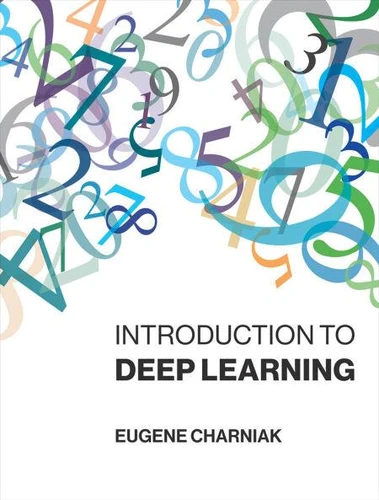
Introduction to Deep Learning
Par :Formats :
Disponible dans votre compte client Decitre ou Furet du Nord dès validation de votre commande. Le format ePub protégé est :
- Compatible avec une lecture sur My Vivlio (smartphone, tablette, ordinateur)
- Compatible avec une lecture sur liseuses Vivlio
- Pour les liseuses autres que Vivlio, vous devez utiliser le logiciel Adobe Digital Edition. Non compatible avec la lecture sur les liseuses Kindle, Remarkable et Sony
- Non compatible avec un achat hors France métropolitaine
 , qui est-ce ?
Notre partenaire de plateforme de lecture numérique où vous retrouverez l'ensemble de vos ebooks gratuitement
Pour en savoir plus sur nos ebooks, consultez notre aide en ligne ici
C'est si simple ! Lisez votre ebook avec l'app Vivlio sur votre tablette, mobile ou ordinateur :

- Nombre de pages192
- FormatePub
- ISBN978-0-262-35164-5
- EAN9780262351645
- Date de parution19/02/2019
- Protection num.Adobe DRM
- Taille5 Mo
- Infos supplémentairesepub
- ÉditeurThe MIT Press
Résumé
A project-based guide to the basics of deep learning. This concise, project-driven guide to deep learning takes readers through a series of program-writing tasks that introduce them to the use of deep learning in such areas of artificial intelligence as computer vision, natural-language processing, and reinforcement learning. The author, a longtime artificial intelligence researcher specializing in natural-language processing, covers feed-forward neural nets, convolutional neural nets, word embeddings, recurrent neural nets, sequence-to-sequence learning, deep reinforcement learning, unsupervised models, and other fundamental concepts and techniques.
Students and practitioners learn the basics of deep learning by working through programs in Tensorflow, an open-source machine learning framework. "I find I learn computer science material best by sitting down and writing programs, " the author writes, and the book reflects this approach. Each chapter includes a programming project, exercises, and references for further reading. An early chapter is devoted to Tensorflow and its interface with Python, the widely used programming language.
Familiarity with linear algebra, multivariate calculus, and probability and statistics is required, as is a rudimentary knowledge of programming in Python. The book can be used in both undergraduate and graduate courses; practitioners will find it an essential reference.
Students and practitioners learn the basics of deep learning by working through programs in Tensorflow, an open-source machine learning framework. "I find I learn computer science material best by sitting down and writing programs, " the author writes, and the book reflects this approach. Each chapter includes a programming project, exercises, and references for further reading. An early chapter is devoted to Tensorflow and its interface with Python, the widely used programming language.
Familiarity with linear algebra, multivariate calculus, and probability and statistics is required, as is a rudimentary knowledge of programming in Python. The book can be used in both undergraduate and graduate courses; practitioners will find it an essential reference.
A propos de Eugène Charniak
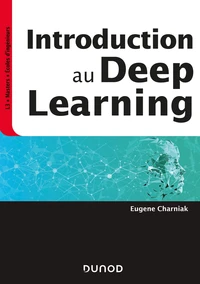
Introduction au Deep Learning
Grand Format
26,90 €