
Professeur d'informatique et de sciences cognitives à l'Université Brown (à Providence, Rhode Island). Il est titulaire d'un doctorat en informatique au M. I. T. Son domaine de recherche est la compréhension des langages naturels.
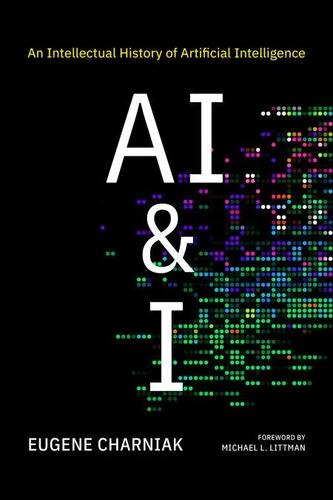
AI & I. An Intellectual History of Artificial Intelligence
Par : ,Formats :
Disponible dans votre compte client Decitre ou Furet du Nord dès validation de votre commande. Le format ePub protégé est :
- Compatible avec une lecture sur My Vivlio (smartphone, tablette, ordinateur)
- Compatible avec une lecture sur liseuses Vivlio
- Pour les liseuses autres que Vivlio, vous devez utiliser le logiciel Adobe Digital Edition. Non compatible avec la lecture sur les liseuses Kindle, Remarkable et Sony
- Non compatible avec un achat hors France métropolitaine
 , qui est-ce ?
Notre partenaire de plateforme de lecture numérique où vous retrouverez l'ensemble de vos ebooks gratuitement
Pour en savoir plus sur nos ebooks, consultez notre aide en ligne ici
C'est si simple ! Lisez votre ebook avec l'app Vivlio sur votre tablette, mobile ou ordinateur :

- Nombre de pages196
- FormatePub
- ISBN978-0-262-37924-3
- EAN9780262379243
- Date de parution08/10/2024
- Protection num.Adobe DRM
- Taille12 Mo
- Infos supplémentairesepub
- ÉditeurThe MIT Press
Résumé
One of AI's earliest and most respected pioneers offers a concise, illuminating history of artificial intelligence-and champions a deep learning approach for future developments. AI & I is an intellectual history of the field of artificial intelligence from the perspective of one of its first practitioners, Eugene Charniak. Charniak entered the field in 1967, roughly 12 years after AI's founding, and was involved in many of AI's formative milestones.
In this book, he traces the trajectory of breakthroughs and disappointments of the discipline up to the current day, clearly and engagingly demystifying this oft revered and misunderstood technology. His argument is controversial but well supported: that classical artificial intelligence has been almost uniformly unsuccessful and that the modern deep learning approach should be viewed as the foundation for all the exciting developments that are to come.
Written for the scientifically educated layperson, this book chronicles the history of the field of artificial intelligence, starting with its origin in 1956, as a topic for a small academic workshop held at Dartmouth University. From there, the author covers reasoning and knowledge representation, reasoning under uncertainty, chess, computer vision, speech recognition, language acquisition, deep learning, and learning writ large.
Ultimately, Charniak takes issue with the controversy of AI-the fear that its invention means the end of jobs, creativity, and potentially even humans as a species-and explains why such concerns are unfounded. Instead, he believes that we should embrace the technology and all its potential to benefit society.
In this book, he traces the trajectory of breakthroughs and disappointments of the discipline up to the current day, clearly and engagingly demystifying this oft revered and misunderstood technology. His argument is controversial but well supported: that classical artificial intelligence has been almost uniformly unsuccessful and that the modern deep learning approach should be viewed as the foundation for all the exciting developments that are to come.
Written for the scientifically educated layperson, this book chronicles the history of the field of artificial intelligence, starting with its origin in 1956, as a topic for a small academic workshop held at Dartmouth University. From there, the author covers reasoning and knowledge representation, reasoning under uncertainty, chess, computer vision, speech recognition, language acquisition, deep learning, and learning writ large.
Ultimately, Charniak takes issue with the controversy of AI-the fear that its invention means the end of jobs, creativity, and potentially even humans as a species-and explains why such concerns are unfounded. Instead, he believes that we should embrace the technology and all its potential to benefit society.
A propos de Eugène Charniak
Introduction au Deep Learning
Grand Format
26,90 €
34,33 €