
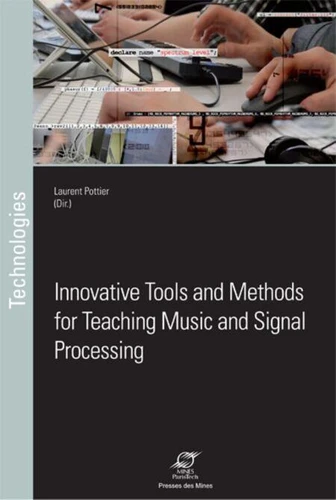
Innovative tools and methods for teaching music and signal processing
Par :Formats :
Disponible dans votre compte client Decitre ou Furet du Nord dès validation de votre commande. Le format PDF est :
- Compatible avec une lecture sur My Vivlio (smartphone, tablette, ordinateur)
- Compatible avec une lecture sur liseuses Vivlio
- Pour les liseuses autres que Vivlio, vous devez utiliser le logiciel Adobe Digital Edition. Non compatible avec la lecture sur les liseuses Kindle, Remarkable et Sony
 , qui est-ce ?
Notre partenaire de plateforme de lecture numérique où vous retrouverez l'ensemble de vos ebooks gratuitement
Pour en savoir plus sur nos ebooks, consultez notre aide en ligne ici
C'est si simple ! Lisez votre ebook avec l'app Vivlio sur votre tablette, mobile ou ordinateur :

- Nombre de pages224
- FormatPDF
- ISBN978-2-494532-74-8
- EAN9782494532748
- Date de parution19/12/2022
- Protection num.pas de protection
- Infos supplémentairespdf
- ÉditeurPresses des Mines - Transvalor
Résumé
Digital technologies offer new means of expression in the field of music allowing us to explore areas of unlimited and unprecedented sound and expressiveness.
It is, therefore, important to train future generations regarding these tools from experimental and multidisciplinary perspectives to ensure that musical creation will evolve and fully exploit the possibilities these technologies offer.
With this in mind, we have collected for this book fifteen texts written by researchers, teachers, musicians, composers and Ph.
D. students of various backgrounds, each having an innovative and individual practice of teaching music or signal processing. The book was published following a conference held on 2 and 3 November, 2015 at the University of Saint-Etienne, organized by the CIEREC (Interdisciplinary Center for Studies and Research on Contemporary Expression) in partnership with GRAME. It has been partially funded by the FEEVER project [ANR-13- BS02-0008] supported by the Agence nationale pour la recherche
D. students of various backgrounds, each having an innovative and individual practice of teaching music or signal processing. The book was published following a conference held on 2 and 3 November, 2015 at the University of Saint-Etienne, organized by the CIEREC (Interdisciplinary Center for Studies and Research on Contemporary Expression) in partnership with GRAME. It has been partially funded by the FEEVER project [ANR-13- BS02-0008] supported by the Agence nationale pour la recherche
A propos de Laurent Pottier

39,00 €