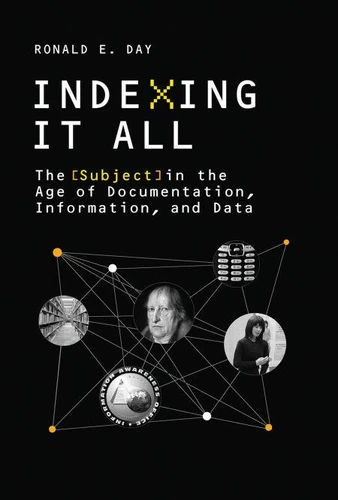
A critical history of the modern tradition of documentation, tracing the representation of individuals and groups in the form of documents, information, and data. In this book, Ronald Day offers a critical history of the modern tradition of documentation. Focusing on the documentary index (understood as a mode of social positioning), and drawing on the work of the French documentalist Suzanne Briet, Day explores the understanding and uses of indexicality.
He examines the transition as indexes went from being explicit professional structures that mediated users and documents to being implicit infrastructural devices used in everyday information and communication acts. Doing so, he also traces three epistemic eras in the representation of individuals and groups, first in the forms of documents, then information, then data. Day investigates five cases from the modern tradition of documentation.
He considers the socio-technical instrumentalism of Paul Otlet, "the father of European documentation" (contrasting it to the hermeneutic perspective of Martin Heidegger); the shift from documentation to information science and the accompanying transformation of persons and texts into users and information; social media's use of algorithms, further subsuming persons and texts; attempts to build android robots-to embody human agency within an information system that resembles a human being; and social "big data" as a technique of neoliberal governance that employs indexing and analytics for purposes of surveillance.
Finally, Day considers the status of critique and judgment at a time when people and their rights of judgment are increasingly mediated, displaced, and replaced by modern documentary techniques.
A critical history of the modern tradition of documentation, tracing the representation of individuals and groups in the form of documents, information, and data. In this book, Ronald Day offers a critical history of the modern tradition of documentation. Focusing on the documentary index (understood as a mode of social positioning), and drawing on the work of the French documentalist Suzanne Briet, Day explores the understanding and uses of indexicality.
He examines the transition as indexes went from being explicit professional structures that mediated users and documents to being implicit infrastructural devices used in everyday information and communication acts. Doing so, he also traces three epistemic eras in the representation of individuals and groups, first in the forms of documents, then information, then data. Day investigates five cases from the modern tradition of documentation.
He considers the socio-technical instrumentalism of Paul Otlet, "the father of European documentation" (contrasting it to the hermeneutic perspective of Martin Heidegger); the shift from documentation to information science and the accompanying transformation of persons and texts into users and information; social media's use of algorithms, further subsuming persons and texts; attempts to build android robots-to embody human agency within an information system that resembles a human being; and social "big data" as a technique of neoliberal governance that employs indexing and analytics for purposes of surveillance.
Finally, Day considers the status of critique and judgment at a time when people and their rights of judgment are increasingly mediated, displaced, and replaced by modern documentary techniques.

 , qui est-ce ?
