Die Kulturwissenschaftlerin Dr. Astrid Schwabe ist Juniorprofessorin für Public History sowie historisches Lernen im Sachunterricht am Seminar für Geschichte und Geschichtsdidaktik der Europa-Universität Flensburg.
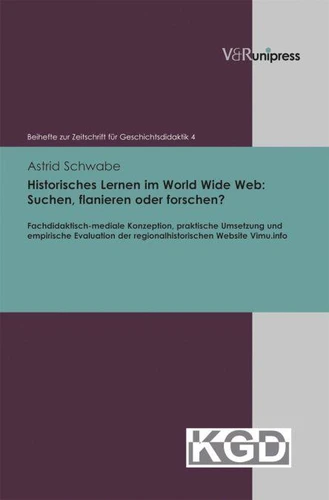
Historisches Lernen im World Wide Web: Suchen, flanieren oder forschen?. Fachdidaktisch-mediale Konzeption, praktische Umsetzung und empirische Evaluation der regionalhistorischen Website Vimu.info
Par : ,Formats :
Disponible dans votre compte client Decitre ou Furet du Nord dès validation de votre commande. Le format PDF est :
- Compatible avec une lecture sur My Vivlio (smartphone, tablette, ordinateur)
- Compatible avec une lecture sur liseuses Vivlio
- Pour les liseuses autres que Vivlio, vous devez utiliser le logiciel Adobe Digital Edition. Non compatible avec la lecture sur les liseuses Kindle, Remarkable et Sony
 , qui est-ce ?
Notre partenaire de plateforme de lecture numérique où vous retrouverez l'ensemble de vos ebooks gratuitement
Pour en savoir plus sur nos ebooks, consultez notre aide en ligne ici
C'est si simple ! Lisez votre ebook avec l'app Vivlio sur votre tablette, mobile ou ordinateur :

- Nombre de pages479
- FormatPDF
- ISBN978-3-86234-996-8
- EAN9783862349968
- Date de parution03/12/2012
- Protection num.pas de protection
- Taille4 Mo
- Infos supplémentairespdf
- ÉditeurV&R Unipress
Résumé
When we are online, we learn about history in very specific ways - the characteristics of networked media heavily influence the content and structure of historical narratives. What is the potential of the internet for researching, learning and teaching history? What are the risks? What are the didactical requirements for presenting history online? Astrid Schwabe's empirical research draws on both media studies and the didactics of history.
Grounded in didactical research and media theory, Schwabe develops a concept for a virtual history museum. This concept forms the basis for the implementation of the didactical history website www.vimu.info. An empiric evaluation of the website and its users gives unique insights into people's history learning online. Based on these results, Schwabe develops a theory of online history reception and user types.
The study is in the field of "Geschichtskultur", that is learning and teaching history outside of academic institutions.
Grounded in didactical research and media theory, Schwabe develops a concept for a virtual history museum. This concept forms the basis for the implementation of the didactical history website www.vimu.info. An empiric evaluation of the website and its users gives unique insights into people's history learning online. Based on these results, Schwabe develops a theory of online history reception and user types.
The study is in the field of "Geschichtskultur", that is learning and teaching history outside of academic institutions.