SOLDES
Jusqu'à -70% sur une sélection d'articles*

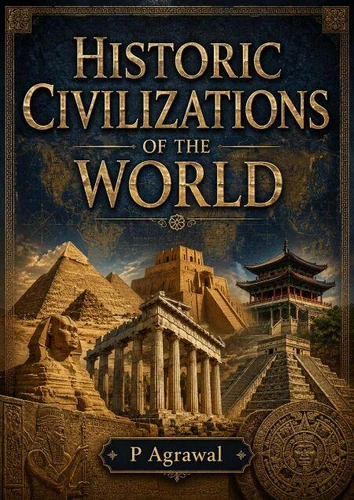
Historic Civilizations Of The World: Overview of major historic civilizations worldwide
Par :Formats :
Disponible dans votre compte client Decitre ou Furet du Nord dès validation de votre commande. Le format ePub est :
- Compatible avec une lecture sur My Vivlio (smartphone, tablette, ordinateur)
- Compatible avec une lecture sur liseuses Vivlio
- Pour les liseuses autres que Vivlio, vous devez utiliser le logiciel Adobe Digital Edition. Non compatible avec la lecture sur les liseuses Kindle, Remarkable et Sony
 , qui est-ce ?
Notre partenaire de plateforme de lecture numérique où vous retrouverez l'ensemble de vos ebooks gratuitement
Pour en savoir plus sur nos ebooks, consultez notre aide en ligne ici
C'est si simple ! Lisez votre ebook avec l'app Vivlio sur votre tablette, mobile ou ordinateur :

- FormatePub
- ISBN8235647336
- EAN9798235647336
- Date de parution09/05/2026
- Protection num.pas de protection
- Infos supplémentairesepub
- ÉditeurIoakim Ioakim
Résumé
Historic Civilizations Of The World is an accessible and thoughtful guide to the rise, structure, survival, and transformation of human societies across time. Rather than treating civilization as a fixed label or a simple checklist of cities, monuments, kings, and wars, the book invites readers to look beneath the surface and understand the deeper systems that allowed historic communities to grow into complex societies.
It explains that civilizations were not built by grandeur alone, but by food production, water management, record keeping, trade, law, craft, religion, urban planning, and the ability to coordinate people under changing conditions. The book begins by questioning the very meaning of the word "civilization, " showing how the term can both help and mislead. It encourages readers to examine how historians and archaeologists interpret evidence, from written records and architecture to pottery, tools, burial customs, and settlement patterns.
Through this approach, the reader learns that every civilization must be studied on its own terms, with attention to geography, environment, resources, belief systems, and social organization. A major strength of the book is its emphasis on everyday foundations. It shows that before palaces could rise or empires could expand, societies had to solve practical problems: how to grow enough food, store surplus grain, distribute water, organize labor, settle disputes, and preserve knowledge.
Cities are presented not merely as large settlements, but as engines of trade, administration, culture, specialization, and innovation. Writing and calculation are explored as tools of memory and power, while religion and ritual are shown as social forces that gave meaning, order, and rhythm to public life. The book also highlights the essential skills that sustained civilizations: measurement, craftsmanship, metallurgy, education, governance, transport, maintenance, and resilience.
It explains how disruption-whether caused by drought, war, disease, political rivalry, or shifting trade routes-tested the strength of every society. Civilizations did not always end suddenly; many transformed, reorganized, or passed their knowledge into later cultures. This perspective makes the book especially valuable because it replaces the old idea of simple "rise and fall" with a more realistic understanding of growth, stress, adaptation, and continuity.
Written in clear, bookish language, Historic Civilizations Of The World is suitable for students, general readers, history lovers, and anyone seeking a broad but grounded introduction to the ancient and historic world. It does not reduce history to famous names and dates. Instead, it teaches readers how to think historically: to ask better questions, compare societies carefully, respect the limits of evidence, and see civilization as a living network of people, resources, institutions, beliefs, and skills.
This book is ultimately a guide to understanding how humanity learned to build organized life-and how those achievements continue to shape the modern world.
It explains that civilizations were not built by grandeur alone, but by food production, water management, record keeping, trade, law, craft, religion, urban planning, and the ability to coordinate people under changing conditions. The book begins by questioning the very meaning of the word "civilization, " showing how the term can both help and mislead. It encourages readers to examine how historians and archaeologists interpret evidence, from written records and architecture to pottery, tools, burial customs, and settlement patterns.
Through this approach, the reader learns that every civilization must be studied on its own terms, with attention to geography, environment, resources, belief systems, and social organization. A major strength of the book is its emphasis on everyday foundations. It shows that before palaces could rise or empires could expand, societies had to solve practical problems: how to grow enough food, store surplus grain, distribute water, organize labor, settle disputes, and preserve knowledge.
Cities are presented not merely as large settlements, but as engines of trade, administration, culture, specialization, and innovation. Writing and calculation are explored as tools of memory and power, while religion and ritual are shown as social forces that gave meaning, order, and rhythm to public life. The book also highlights the essential skills that sustained civilizations: measurement, craftsmanship, metallurgy, education, governance, transport, maintenance, and resilience.
It explains how disruption-whether caused by drought, war, disease, political rivalry, or shifting trade routes-tested the strength of every society. Civilizations did not always end suddenly; many transformed, reorganized, or passed their knowledge into later cultures. This perspective makes the book especially valuable because it replaces the old idea of simple "rise and fall" with a more realistic understanding of growth, stress, adaptation, and continuity.
Written in clear, bookish language, Historic Civilizations Of The World is suitable for students, general readers, history lovers, and anyone seeking a broad but grounded introduction to the ancient and historic world. It does not reduce history to famous names and dates. Instead, it teaches readers how to think historically: to ask better questions, compare societies carefully, respect the limits of evidence, and see civilization as a living network of people, resources, institutions, beliefs, and skills.
This book is ultimately a guide to understanding how humanity learned to build organized life-and how those achievements continue to shape the modern world.
A propos de P. Agrawal



2,99 €



2,99 €