SOLDES
Jusqu'à -70% sur une sélection d'articles*

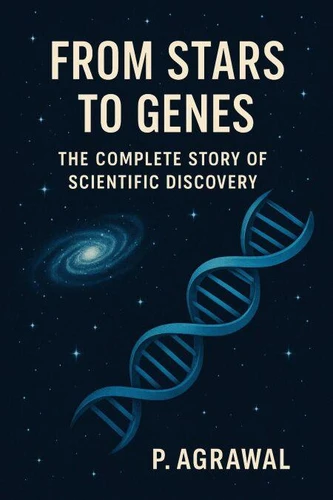
From Stars to Genes: The Complete Story of Scientific Discovery
Par :Formats :
Disponible dans votre compte client Decitre ou Furet du Nord dès validation de votre commande. Le format ePub est :
- Compatible avec une lecture sur My Vivlio (smartphone, tablette, ordinateur)
- Compatible avec une lecture sur liseuses Vivlio
- Pour les liseuses autres que Vivlio, vous devez utiliser le logiciel Adobe Digital Edition. Non compatible avec la lecture sur les liseuses Kindle, Remarkable et Sony
 , qui est-ce ?
Notre partenaire de plateforme de lecture numérique où vous retrouverez l'ensemble de vos ebooks gratuitement
Pour en savoir plus sur nos ebooks, consultez notre aide en ligne ici
C'est si simple ! Lisez votre ebook avec l'app Vivlio sur votre tablette, mobile ou ordinateur :

- FormatePub
- ISBN8230046189
- EAN9798230046189
- Date de parution23/10/2025
- Protection num.pas de protection
- Infos supplémentairesepub
- ÉditeurIndependently Published
Résumé
From Stars to Genes: The Complete Story of Scientific Discovery is a lucid, link-by-link narrative of how humanity learned the rules of reality-from the birth and growth of the universe to the molecular code inside living cells. In sixteen interconnected chapters, it begins with ancient sky-watchers and the rise of telescopes, then follows the mapping of the heavens into the deep insights of light, atoms, and the immense energies hidden within matter.
Readers meet the four fundamental forces not as abstract equations, but as everyday guides that connect falling apples, glowing light bulbs, and the fusion fires of stars. Turning inward, the book traces how water, carbon, and energy flows build the chemistry of life, how cells operate as living machines, and how evolution's evidence-from fossils to DNA-reveals a branching history that unites all species.
The genetic code is presented as a readable, writable library, showing how sequences become proteins and how cells regulate, repair, and remember. Modern frontiers-precision gene editing, synthetic circuits, and responsible biotechnology-are explained gently and clearly, with attention to safety, equity, and ethics. The narrative then widens again to cosmic time: how the universe expands, why ancient light still bathes the sky, and what dark matter and dark energy imply for the future.
Thermodynamics and entropy are rendered in everyday language, revealing the arrow of time behind engines, climates, and life's steady maintenance of order. A calm, practical tour of the brain shows how neurons, glia, and plastic circuits give rise to perception, memory, language, and decision, grounding mind in living matter without diminishing its depth. A chapter on life's origins offers a plausible, stepwise path from simple chemistry to protocells, while the search for life elsewhere is weighed with humility and rigor.
The closing unified vision threads recurring themes-regularities, emergence, feedback, information, and time-into a humane picture of science as a shared, self-correcting craft: observe carefully, model clearly, test honestly, and revise together. Written in simple, bookish language with minimal jargon, this is both primer and panorama-ideal for students, lifelong learners, and curious readers. It can be read straight through as a grand story or dipped into for clear explanations of specific topics.
Above all, it invites readers to see the connections: how a few basic rules allow complex beauty, how starlight becomes seawater, seawater becomes cells, cells become minds-and minds learn to care for the world they now understand.
Readers meet the four fundamental forces not as abstract equations, but as everyday guides that connect falling apples, glowing light bulbs, and the fusion fires of stars. Turning inward, the book traces how water, carbon, and energy flows build the chemistry of life, how cells operate as living machines, and how evolution's evidence-from fossils to DNA-reveals a branching history that unites all species.
The genetic code is presented as a readable, writable library, showing how sequences become proteins and how cells regulate, repair, and remember. Modern frontiers-precision gene editing, synthetic circuits, and responsible biotechnology-are explained gently and clearly, with attention to safety, equity, and ethics. The narrative then widens again to cosmic time: how the universe expands, why ancient light still bathes the sky, and what dark matter and dark energy imply for the future.
Thermodynamics and entropy are rendered in everyday language, revealing the arrow of time behind engines, climates, and life's steady maintenance of order. A calm, practical tour of the brain shows how neurons, glia, and plastic circuits give rise to perception, memory, language, and decision, grounding mind in living matter without diminishing its depth. A chapter on life's origins offers a plausible, stepwise path from simple chemistry to protocells, while the search for life elsewhere is weighed with humility and rigor.
The closing unified vision threads recurring themes-regularities, emergence, feedback, information, and time-into a humane picture of science as a shared, self-correcting craft: observe carefully, model clearly, test honestly, and revise together. Written in simple, bookish language with minimal jargon, this is both primer and panorama-ideal for students, lifelong learners, and curious readers. It can be read straight through as a grand story or dipped into for clear explanations of specific topics.
Above all, it invites readers to see the connections: how a few basic rules allow complex beauty, how starlight becomes seawater, seawater becomes cells, cells become minds-and minds learn to care for the world they now understand.
A propos de P. Agrawal





2,99 €







2,99 €