SOLDES
Jusqu'à -70% sur une sélection d'articles*

Harvard Law Review: Volume 127, Number 8 - June 2014
Par :Formats :
Disponible dans votre compte client Decitre ou Furet du Nord dès validation de votre commande. Le format ePub est :
- Compatible avec une lecture sur My Vivlio (smartphone, tablette, ordinateur)
- Compatible avec une lecture sur liseuses Vivlio
- Pour les liseuses autres que Vivlio, vous devez utiliser le logiciel Adobe Digital Edition. Non compatible avec la lecture sur les liseuses Kindle, Remarkable et Sony
 , qui est-ce ?
Notre partenaire de plateforme de lecture numérique où vous retrouverez l'ensemble de vos ebooks gratuitement
Pour en savoir plus sur nos ebooks, consultez notre aide en ligne ici
C'est si simple ! Lisez votre ebook avec l'app Vivlio sur votre tablette, mobile ou ordinateur :

- FormatePub
- ISBN978-1-61027-864-5
- EAN9781610278645
- Date de parution08/06/2014
- Protection num.pas de protection
- Infos supplémentairesepub
- ÉditeurMark Childress
Résumé
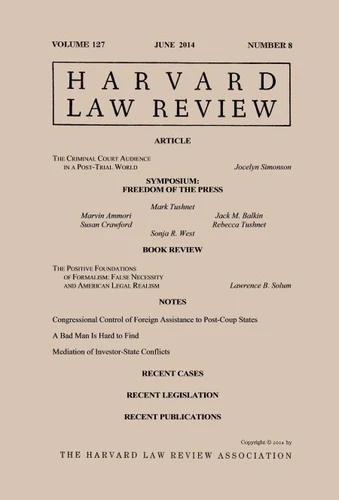
Harvard Law Review, Number 8 (June 2014), includes an extensive Symposium on Freedom of the Press, as well as an article, "The Criminal Court Audience in a Post-Trial World, " by Jocelyn Simonson, and a book review essay, "The Positive Foundations of Formalism: False Necessity and American Legal Realism, " by Lawrence B. Solum. Specifically, the Symposium on press freedoms features:* "Introduction: Reflections on the First Amendment and the Information Economy, " by Mark Tushnet* "The 'New' New York Times: Free Speech Lawyering in the Age of Google and Twitter, " by Marvin Ammori* "Old-School/New-School Speech Regulation, " by Jack M.
Balkin* "First Amendment Common Sense, " by Susan Crawford* "More than a Feeling: Emotion and the First Amendment, " by Rebecca Tushnet* "Press Exceptionalism, " by Sonja R. WestThe issue includes these student contributions:* Note, "Congressional Control of Foreign Assistance to Post-Coup States"* Note, "A Bad Man Is Hard to Find"* Note, "Mediation of Investor-State Conflicts"In addition, case notes explore Recent Cases on such subjects as the FCC power to create Open Internet rules; whether enforcement of a foreign judgment is state action; and threat convictions in internet free speech cases; as well as Recent Legislation on immigration law and local entity compliance in California.
The issue includes several Recent Publications summaries. Finally, as the final issue of volume 127, it contains a comprehensive Index of each article, essay, book review, and student work from the year. The Harvard Law Review is offered in a quality digital edition, featuring active Contents, linked notes, active URLs in notes, and proper ebook and Bluebook formatting. The Review is a student-run organization whose primary purpose is to publish a journal of legal scholarship.
The organization is formally independent of the Harvard Law School. Student editors make all editorial and organizational decisions.
Balkin* "First Amendment Common Sense, " by Susan Crawford* "More than a Feeling: Emotion and the First Amendment, " by Rebecca Tushnet* "Press Exceptionalism, " by Sonja R. WestThe issue includes these student contributions:* Note, "Congressional Control of Foreign Assistance to Post-Coup States"* Note, "A Bad Man Is Hard to Find"* Note, "Mediation of Investor-State Conflicts"In addition, case notes explore Recent Cases on such subjects as the FCC power to create Open Internet rules; whether enforcement of a foreign judgment is state action; and threat convictions in internet free speech cases; as well as Recent Legislation on immigration law and local entity compliance in California.
The issue includes several Recent Publications summaries. Finally, as the final issue of volume 127, it contains a comprehensive Index of each article, essay, book review, and student work from the year. The Harvard Law Review is offered in a quality digital edition, featuring active Contents, linked notes, active URLs in notes, and proper ebook and Bluebook formatting. The Review is a student-run organization whose primary purpose is to publish a journal of legal scholarship.
The organization is formally independent of the Harvard Law School. Student editors make all editorial and organizational decisions.