SOLDES
Jusqu'à -70% sur une sélection d'articles*

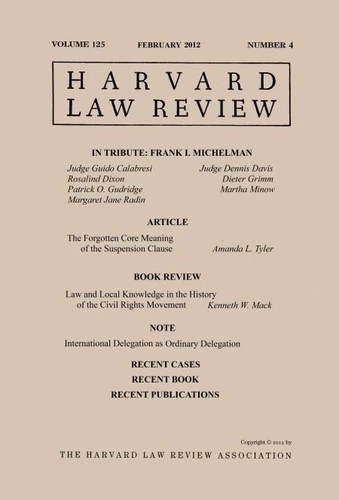
Harvard Law Review: Volume 125, Number 4 - February 2012
Par :Formats :
Disponible dans votre compte client Decitre ou Furet du Nord dès validation de votre commande. Le format ePub est :
- Compatible avec une lecture sur My Vivlio (smartphone, tablette, ordinateur)
- Compatible avec une lecture sur liseuses Vivlio
- Pour les liseuses autres que Vivlio, vous devez utiliser le logiciel Adobe Digital Edition. Non compatible avec la lecture sur les liseuses Kindle, Remarkable et Sony
 , qui est-ce ?
Notre partenaire de plateforme de lecture numérique où vous retrouverez l'ensemble de vos ebooks gratuitement
Pour en savoir plus sur nos ebooks, consultez notre aide en ligne ici
C'est si simple ! Lisez votre ebook avec l'app Vivlio sur votre tablette, mobile ou ordinateur :

- FormatePub
- ISBN978-1-61027-959-8
- EAN9781610279598
- Date de parution15/02/2014
- Protection num.pas de protection
- Infos supplémentairesepub
- ÉditeurMark Childress
Résumé
Featured articles in this Feb. 2012 issue are from such recognized scholars as Amanda Tyler, on the core meaning of the Suspension Clause, and Kenneth Mack, reviewing Tomiko Brown-Nagin's recent book on the grass roots origins of the civil rights movement. Also, several scholars contribute to a tribute honoring Frank Michelman. Student contributions explore the law relating to international delegation, the First Amendment and student speech, criminal sentencing, public jury selection, sovereign immunity for alien tort claims, and corporate governance.
Finally, the issue includes several Book Notes. The Harvard Law Review is a student-run organization whose primary purpose is to publish a journal of legal scholarship. The Review comes out monthly from November through June and has roughly 2500 pages per volume. The organization is formally independent of the Harvard Law School. Student editors make all editorial and organizational decisions. Aside from serving as an important academic forum for legal scholarship, the Review has two other goals.
First, the journal is designed to be an effective research tool for practicing lawyers and students of the law. Second, it provides opportunities for Review members to develop their own editing and writing skills. Accordingly, each issue contains pieces by student editors as well as outside authors. The Review generally publishes articles by professors, judges, and practitioners and solicits reviews of important recent books from recognized experts.
Most student writing takes the form of Notes, Recent Cases, Recent Legislation, and Book Notes. This issue of the Review is February 2012, the fourth issue of academic year 2011-2012 (Volume 125).
Finally, the issue includes several Book Notes. The Harvard Law Review is a student-run organization whose primary purpose is to publish a journal of legal scholarship. The Review comes out monthly from November through June and has roughly 2500 pages per volume. The organization is formally independent of the Harvard Law School. Student editors make all editorial and organizational decisions. Aside from serving as an important academic forum for legal scholarship, the Review has two other goals.
First, the journal is designed to be an effective research tool for practicing lawyers and students of the law. Second, it provides opportunities for Review members to develop their own editing and writing skills. Accordingly, each issue contains pieces by student editors as well as outside authors. The Review generally publishes articles by professors, judges, and practitioners and solicits reviews of important recent books from recognized experts.
Most student writing takes the form of Notes, Recent Cases, Recent Legislation, and Book Notes. This issue of the Review is February 2012, the fourth issue of academic year 2011-2012 (Volume 125).