SOLDES
Jusqu'à -70% sur une sélection d'articles*

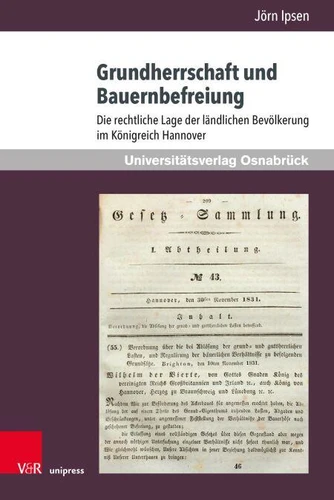
Grundherrschaft und Bauernbefreiung. Die rechtliche Lage der ländlichen Bevölkerung im Königreich Hannover
Par :Formats :
Disponible dans votre compte client Decitre ou Furet du Nord dès validation de votre commande. Le format PDF est :
- Compatible avec une lecture sur My Vivlio (smartphone, tablette, ordinateur)
- Compatible avec une lecture sur liseuses Vivlio
- Pour les liseuses autres que Vivlio, vous devez utiliser le logiciel Adobe Digital Edition. Non compatible avec la lecture sur les liseuses Kindle, Remarkable et Sony
 , qui est-ce ?
Notre partenaire de plateforme de lecture numérique où vous retrouverez l'ensemble de vos ebooks gratuitement
Pour en savoir plus sur nos ebooks, consultez notre aide en ligne ici
C'est si simple ! Lisez votre ebook avec l'app Vivlio sur votre tablette, mobile ou ordinateur :

- Nombre de pages139
- FormatPDF
- ISBN978-3-8470-1340-2
- EAN9783847013402
- Date de parution07/06/2021
- Protection num.pas de protection
- Taille4 Mo
- Infos supplémentairespdf
- ÉditeurV&R Unipress
Résumé
Die Agrarverfassung im Königreich Hannover war bis in das späte 19. Jahrhundert durch ein Auseinanderfallen von Grundeigentum und Bewirtschaftung der landwirtschaftlichen Flächen gekennzeichnet. Grundherren konnten neben den Adligen auch Klöster, Städte und andere Korporationen sowie vermögende Bürger sein. Die aus dem Eigentum fließenden Rechte bestanden in Abgaben und Diensten der abhängigen Bauern.
Die Ablösung der auf den Bauerngütern lastenden Abgaben und Dienste wurde durch die von Johann Carl Bertram Stüve initiierten Gesetze ermöglicht und zog sich über Jahrzehnte hin. Der Wegfall der grundherrlichen Lasten bedeutete zugleich einen sozialen Wandel der ländlichen Bevölkerung im Königreich. Anliegen der vorliegenden Monographie ist es, die Wandlungen der Agrarverfassung des Königreichs Hannover in Parallelität zur Staatsverfassung nachzuzeichnen. The agrarian constitution in the Kingdom of Hanover was characterized by the disparity between the ownership and the cultivation of agricultural land, which dated back to the medieval feudal system.
The landlords were of very different kinds. Besides the nobility, owners could be monasteries, towns and other corporations as well as wealthy citizens. The rights deriving from the ownership consisted of levies - either in kind or in cash - and services of the dependent peasants. The replacement of the levies and services burdening the peasant estates took place in the kingdom through the replacement laws initiated by Johann Carl Bertram Stüve at the beginning of the 1830s.
The replacement of these burdens constituted a process that lasted several decades and at the same time caused a social upheaval of the rural population in the kingdom. Unaffected by the redemption laws were the classes of the rural population below the peasants, who formed a proletariat comparable to the industrial areas of Germany. The aim of this monograph is to trace the changes in the agrarian constitution of the Kingdom of Hanover in parallel with the constitution of the state.
Die Ablösung der auf den Bauerngütern lastenden Abgaben und Dienste wurde durch die von Johann Carl Bertram Stüve initiierten Gesetze ermöglicht und zog sich über Jahrzehnte hin. Der Wegfall der grundherrlichen Lasten bedeutete zugleich einen sozialen Wandel der ländlichen Bevölkerung im Königreich. Anliegen der vorliegenden Monographie ist es, die Wandlungen der Agrarverfassung des Königreichs Hannover in Parallelität zur Staatsverfassung nachzuzeichnen. The agrarian constitution in the Kingdom of Hanover was characterized by the disparity between the ownership and the cultivation of agricultural land, which dated back to the medieval feudal system.
The landlords were of very different kinds. Besides the nobility, owners could be monasteries, towns and other corporations as well as wealthy citizens. The rights deriving from the ownership consisted of levies - either in kind or in cash - and services of the dependent peasants. The replacement of the levies and services burdening the peasant estates took place in the kingdom through the replacement laws initiated by Johann Carl Bertram Stüve at the beginning of the 1830s.
The replacement of these burdens constituted a process that lasted several decades and at the same time caused a social upheaval of the rural population in the kingdom. Unaffected by the redemption laws were the classes of the rural population below the peasants, who formed a proletariat comparable to the industrial areas of Germany. The aim of this monograph is to trace the changes in the agrarian constitution of the Kingdom of Hanover in parallel with the constitution of the state.