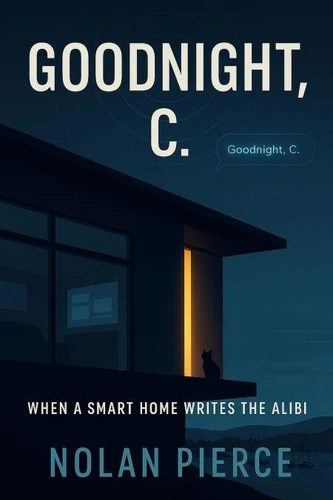
A stray cat wanders home with someone else's blood in its fur, and reporter Maeve Carter follows the trail to a hilltop house that talks back. The screens glow on cue. A voice from the landing answers the wake word. The homeowner says his brother is upstairs watching the game-yet everything about the scene feels. rehearsed. What begins as a neighborhood oddity becomes a smart home thriller about presence faked by design, where device logs, heat, and habit tell a truer story than any witness.
With Det. Inez Ruiz-patient, methodical, unbluffable-and Theo Lark, a teenage tinkerer who hears latency like rhythm, Maeve peels back the choreography: pre-scheduled voice routines, looped shadows, and a media wall that opens onto a temperature-controlled cavity. Downriver, a covered cart and a weighted tarp hint at a relocation without gore. In the server closet, an alibi has a name-"Goodnight, C."-and a timestamp that fires minutes after Maeve's 911 call.
As pressure mounts around an IPO and a missing person mystery refuses to stay tidy, the truth survives in echoes-and in rooms that remember. Told with the pace of a techno-thriller and the intimacy of domestic noir, this is a case built from tolerances and timestamps, not jump scares. The investigation plays fair: every crucial clue appears in plain sight, from a one-millimeter misfit along a panel seam to a smart-scale reading that is almost right.
Ruiz's measured approach grounds the story in a crisp police procedural frame, while Maeve's eye for ordinary details turns digital forensics into narrative fuel. Beneath the puzzle runs a human current-a psychological thriller about comfort engineered to look like truth, and the cost of teaching our homes to speak for us. For fans of Black Mirror-style suspense, procedural puzzles, and sleek modern mysteries that don't need gore to haunt you.
When screens can perform life, what-exactly-counts as proof?
A stray cat wanders home with someone else's blood in its fur, and reporter Maeve Carter follows the trail to a hilltop house that talks back. The screens glow on cue. A voice from the landing answers the wake word. The homeowner says his brother is upstairs watching the game-yet everything about the scene feels. rehearsed. What begins as a neighborhood oddity becomes a smart home thriller about presence faked by design, where device logs, heat, and habit tell a truer story than any witness.
With Det. Inez Ruiz-patient, methodical, unbluffable-and Theo Lark, a teenage tinkerer who hears latency like rhythm, Maeve peels back the choreography: pre-scheduled voice routines, looped shadows, and a media wall that opens onto a temperature-controlled cavity. Downriver, a covered cart and a weighted tarp hint at a relocation without gore. In the server closet, an alibi has a name-"Goodnight, C."-and a timestamp that fires minutes after Maeve's 911 call.
As pressure mounts around an IPO and a missing person mystery refuses to stay tidy, the truth survives in echoes-and in rooms that remember. Told with the pace of a techno-thriller and the intimacy of domestic noir, this is a case built from tolerances and timestamps, not jump scares. The investigation plays fair: every crucial clue appears in plain sight, from a one-millimeter misfit along a panel seam to a smart-scale reading that is almost right.
Ruiz's measured approach grounds the story in a crisp police procedural frame, while Maeve's eye for ordinary details turns digital forensics into narrative fuel. Beneath the puzzle runs a human current-a psychological thriller about comfort engineered to look like truth, and the cost of teaching our homes to speak for us. For fans of Black Mirror-style suspense, procedural puzzles, and sleek modern mysteries that don't need gore to haunt you.
When screens can perform life, what-exactly-counts as proof?

 , qui est-ce ?