Writes about frontier mythology, territorial conflict, and political storytelling.
Nouveauté
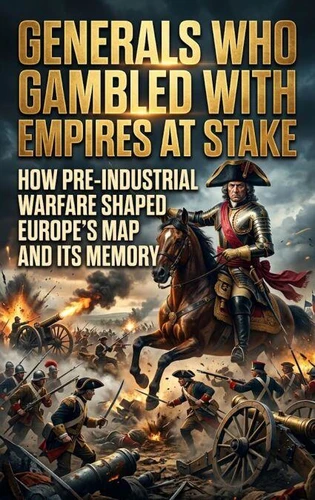
Generals who gambled with empires at stake. How pre-industrial warfare shaped Europe's map and its memory
Par :Formats :
Disponible dans votre compte client Decitre ou Furet du Nord dès validation de votre commande. Le format ePub est :
- Compatible avec une lecture sur My Vivlio (smartphone, tablette, ordinateur)
- Compatible avec une lecture sur liseuses Vivlio
- Pour les liseuses autres que Vivlio, vous devez utiliser le logiciel Adobe Digital Edition. Non compatible avec la lecture sur les liseuses Kindle, Remarkable et Sony
 , qui est-ce ?
Notre partenaire de plateforme de lecture numérique où vous retrouverez l'ensemble de vos ebooks gratuitement
Pour en savoir plus sur nos ebooks, consultez notre aide en ligne ici
C'est si simple ! Lisez votre ebook avec l'app Vivlio sur votre tablette, mobile ou ordinateur :

- Nombre de pages209
- FormatePub
- ISBN978-3-565-55552-9
- EAN9783565555529
- Date de parution10/07/2026
- Protection num.pas de protection
- Taille656 Ko
- Infos supplémentairesepub
- ÉditeurEmphaloz Publishing House
Résumé
What drove a Roman general to commit his legions at Cannae, and what made Hannibal certain he would? Before gunpowder, before real-time intelligence, commanders faced choices where one mistake erased cities. This book reconstructs the logic behind pre-industrial military decisions-not through battle diagrams, but through the constraints, assumptions, and information gaps that shaped them. It examines how generals weighed supply lines against morale, terrain against timing, and discipline against desperation.
From the plains of Gaul to the walls of Constantinople, the same patterns recur: leaders operating with partial knowledge, betting on human endurance, and calculating risks that modern officers would reject. The book argues that pre-industrial strategy was less about genius than about managing uncertainty. It shows how logistics limited ambition, how weather dictated timetables, and how the fear of mutiny shaped campaigns more than any theory of war.
For readers interested in how power actually worked before the modern age, this study offers a ground-level view of decision-making under impossible conditions-and asks what those decisions reveal about the nature of command itself.
From the plains of Gaul to the walls of Constantinople, the same patterns recur: leaders operating with partial knowledge, betting on human endurance, and calculating risks that modern officers would reject. The book argues that pre-industrial strategy was less about genius than about managing uncertainty. It shows how logistics limited ambition, how weather dictated timetables, and how the fear of mutiny shaped campaigns more than any theory of war.
For readers interested in how power actually worked before the modern age, this study offers a ground-level view of decision-making under impossible conditions-and asks what those decisions reveal about the nature of command itself.
A propos de Brandon Lockwood




24,99 €
24,99 €