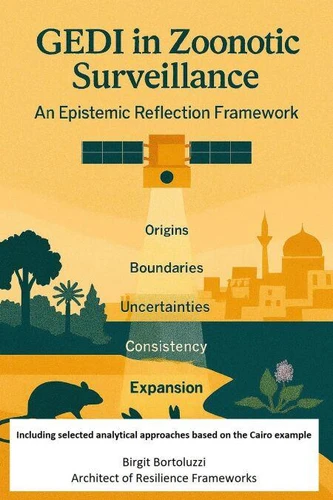
GEDI in Zoonotic Surveillance – An Epistemic Reflection Framework. Including selected analytical approaches based on the Cairo example
Par :Formats :
Disponible dans votre compte client Decitre ou Furet du Nord dès validation de votre commande. Le format ePub est :
- Compatible avec une lecture sur My Vivlio (smartphone, tablette, ordinateur)
- Compatible avec une lecture sur liseuses Vivlio
- Pour les liseuses autres que Vivlio, vous devez utiliser le logiciel Adobe Digital Edition. Non compatible avec la lecture sur les liseuses Kindle, Remarkable et Sony
 , qui est-ce ?
Notre partenaire de plateforme de lecture numérique où vous retrouverez l'ensemble de vos ebooks gratuitement
Pour en savoir plus sur nos ebooks, consultez notre aide en ligne ici
C'est si simple ! Lisez votre ebook avec l'app Vivlio sur votre tablette, mobile ou ordinateur :

- Nombre de pages326
- FormatePub
- ISBN978-3-565-19782-8
- EAN9783565197828
- Date de parution26/01/2026
- Protection num.pas de protection
- Taille14 Mo
- Infos supplémentairesepub
- ÉditeurEmphaloz Publishing House
Résumé
Governance Bridge between Earth Observation and One Health - Zoonoses do not arise randomly but at interfaces: between species, landscapes, ecological and human movements and between visible and invisible processes. Many of these interfaces are small, fleeting and complex, raising the question of how global remote sensing systems can detect ecological changes that may create new points of contact.
GEDI provides a structural view of vegetation and landscape, yet only as a small part of a larger observational space. If zoonoses emerge at edges or along animal movements, it becomes essential to consider how far a large scale sensor can make such processes visible and where invisibilities arise that matter for risk assessments. This framework therefore asks how a global structural measurement system can be integrated into a biosurveillance oriented governance model that depends on fine scale, dynamic, functional processes.
It focuses on the conditions under which GEDI shows something, where it shows nothing and how this visibility might relate to zoonotic emergence. This raises questions about how sensor logics, data gaps, and uncertainties interact and how governance systems might make these interactions transparent and epistemically safe. To make this more tangible, a Cairo scenario with several analytical layers translates the framework's considerations into a concrete context and shows how global measurement systems and local dynamics intersect.
The goal is also to ask the right questions and open up crucial perspectives. The work combines conceptual, analytical and governance components to make ecological structures more interpretable for Zoonoses and One Health, highlights potentials visible through GEDI, proposes structural indicators and examines sensor blind spots. Core elements include the Evidence Integrity Module, the Scale Governance Submodule, a 90 factor set and the GEDI Ecological Structure Baseline, illustrated through urban One Health indicators.
GEDI provides a structural view of vegetation and landscape, yet only as a small part of a larger observational space. If zoonoses emerge at edges or along animal movements, it becomes essential to consider how far a large scale sensor can make such processes visible and where invisibilities arise that matter for risk assessments. This framework therefore asks how a global structural measurement system can be integrated into a biosurveillance oriented governance model that depends on fine scale, dynamic, functional processes.
It focuses on the conditions under which GEDI shows something, where it shows nothing and how this visibility might relate to zoonotic emergence. This raises questions about how sensor logics, data gaps, and uncertainties interact and how governance systems might make these interactions transparent and epistemically safe. To make this more tangible, a Cairo scenario with several analytical layers translates the framework's considerations into a concrete context and shows how global measurement systems and local dynamics intersect.
The goal is also to ask the right questions and open up crucial perspectives. The work combines conceptual, analytical and governance components to make ecological structures more interpretable for Zoonoses and One Health, highlights potentials visible through GEDI, proposes structural indicators and examines sensor blind spots. Core elements include the Evidence Integrity Module, the Scale Governance Submodule, a 90 factor set and the GEDI Ecological Structure Baseline, illustrated through urban One Health indicators.