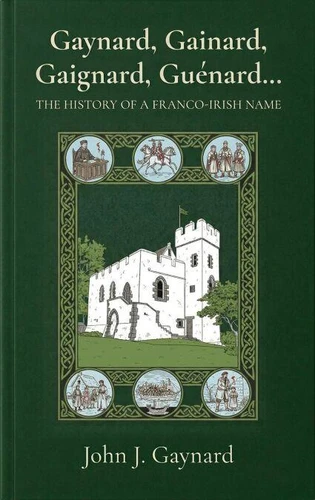
Gaynard, Gainard, Gaignard, Guénard.: The History of a Franco-Irish Name traces the 1, 300-year documented history of a non-royal yet sometimes influential lineage. Drawing on medieval and modern French, German, and Irish Anglo-Norman archives, it constructs a "landscape of occurrences" that follows the name's many variants from their 8th-century Germanic origins to the present day across Europe and North America.
Grounded in onomastic scholarship, the study traces the name to the Germanic stem Kagin and the personal name Gaganhard ("hard against enemies"), first recorded at the Monastery of Mondsee in Bavaria in 749 CE. It follows the transition into the Latin Gainardus in France around 920 CE and the subsequent proliferation of French, English, and Irish forms. A central focus of the book is its contribution to Irish family history and the study of Anglo-Norman Ireland.
It documents the arrival of the Gaynard family in 1238 during the Conquest of Connacht and their nearly four-hundred-year tenure at Carraigin Castle in County Galway, built by the knight Adam Gaynard III around 1300. The narrative traces their evolution into Gaelicised landholding gentry and concludes with the upheaval of Cromwellian dispossession and forced transplantation to the Mullet Peninsula in County Mayo in the 1650s.
The work also offers a portrayal of members of the author's family after the Great Famine in Mayo, documenting their survival as tenant farmers in the Barony of Erris, one of Ireland's most severely affected regions. It identifies a distinctive linguistic survival: the Mayo pronunciation of Gaynard as "Gangyard, " preserving phonetic echoes of medieval French spellings such as Guengnart. Within the broader scope of French genealogy and medieval European history, the "Gainardus Mosaic" reveals a diverse array of historical figures: Crusader Knights: Garinus Gainardus, a nobleman active in 12th-century Antioch and Jerusalem.
Anglo-Norman Officials: Adam Gaynard, among the early Anglo-Norman sheriffs in the province of Connacht. Renaissance Publishers: Étienne Gueynard (Stephen Gaynard), a key figure in the rise of the Lyon printing industry, was responsible for more than 160 works under an innovative publishing policy. Linguistic Scholars: Pierre Le Gaynard, a 17th-century grammarian associated with the French royal court who defended etymological orthography as an "archival voice" against phonetic reformers.
Resistance Figures: Jean Gainard, later recognised as "Righteous Among the Nations" for rescuing Jewish children during the Second World War. The study extends to North America, identifying Huguenot refugees in 17th-century New York, Catholic colonists in Louisiana, and 19th-century Irish emigrants seeking opportunity after the Great Hunger. As a resource for genealogy, the book includes extensive reference tables, including United States Federal Census records (1810-1940) and Mayo birth, marriage, and death registers.
It guides readers to major digital archives such as the French Filae, the French National Library's Gallica, and the Virtual Treasury of Ireland, which works to reconstitute records lost in the 1922 Four Courts fire. Carefully documented and evidence-based, this study reconstructs a lineage from its early Germanic attestations to its 21st-century Irish, French and North American descendants.
Gaynard, Gainard, Gaignard, Guénard.: The History of a Franco-Irish Name traces the 1, 300-year documented history of a non-royal yet sometimes influential lineage. Drawing on medieval and modern French, German, and Irish Anglo-Norman archives, it constructs a "landscape of occurrences" that follows the name's many variants from their 8th-century Germanic origins to the present day across Europe and North America.
Grounded in onomastic scholarship, the study traces the name to the Germanic stem Kagin and the personal name Gaganhard ("hard against enemies"), first recorded at the Monastery of Mondsee in Bavaria in 749 CE. It follows the transition into the Latin Gainardus in France around 920 CE and the subsequent proliferation of French, English, and Irish forms. A central focus of the book is its contribution to Irish family history and the study of Anglo-Norman Ireland.
It documents the arrival of the Gaynard family in 1238 during the Conquest of Connacht and their nearly four-hundred-year tenure at Carraigin Castle in County Galway, built by the knight Adam Gaynard III around 1300. The narrative traces their evolution into Gaelicised landholding gentry and concludes with the upheaval of Cromwellian dispossession and forced transplantation to the Mullet Peninsula in County Mayo in the 1650s.
The work also offers a portrayal of members of the author's family after the Great Famine in Mayo, documenting their survival as tenant farmers in the Barony of Erris, one of Ireland's most severely affected regions. It identifies a distinctive linguistic survival: the Mayo pronunciation of Gaynard as "Gangyard, " preserving phonetic echoes of medieval French spellings such as Guengnart. Within the broader scope of French genealogy and medieval European history, the "Gainardus Mosaic" reveals a diverse array of historical figures: Crusader Knights: Garinus Gainardus, a nobleman active in 12th-century Antioch and Jerusalem.
Anglo-Norman Officials: Adam Gaynard, among the early Anglo-Norman sheriffs in the province of Connacht. Renaissance Publishers: Étienne Gueynard (Stephen Gaynard), a key figure in the rise of the Lyon printing industry, was responsible for more than 160 works under an innovative publishing policy. Linguistic Scholars: Pierre Le Gaynard, a 17th-century grammarian associated with the French royal court who defended etymological orthography as an "archival voice" against phonetic reformers.
Resistance Figures: Jean Gainard, later recognised as "Righteous Among the Nations" for rescuing Jewish children during the Second World War. The study extends to North America, identifying Huguenot refugees in 17th-century New York, Catholic colonists in Louisiana, and 19th-century Irish emigrants seeking opportunity after the Great Hunger. As a resource for genealogy, the book includes extensive reference tables, including United States Federal Census records (1810-1940) and Mayo birth, marriage, and death registers.
It guides readers to major digital archives such as the French Filae, the French National Library's Gallica, and the Virtual Treasury of Ireland, which works to reconstitute records lost in the 1922 Four Courts fire. Carefully documented and evidence-based, this study reconstructs a lineage from its early Germanic attestations to its 21st-century Irish, French and North American descendants.