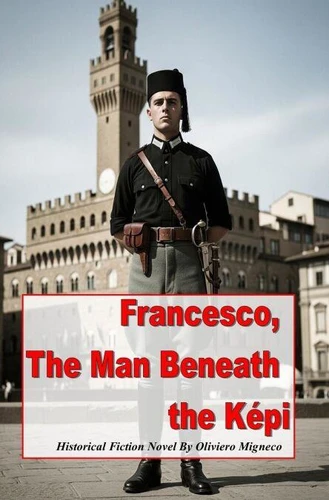
Why Should You Read This BookFrancesco, the Man Beneath the Képi, offers a profound and visceral examination of the twentieth century through the eyes of a man who is not a hero, but a survivor. You should read this book because it refuses to offer simple moral binaries; instead, it takes you inside the mind of Francesco, a young man seduced by the order and aesthetic of Fascism as a cure for the chaos of poverty.
It challenges you to understand how a decent person can be drawn into darkness, forcing you to walk in the boots of a Blackshirt before stripping that identity away to reveal the raw human underneath. The novel provides an immersive, sensory journey spanning three distinct, vividly realized worlds. You will travel from the dusty, sunbaked piazzas of Mussolini's Italy to the suffocating, biological chaos of the "Green Hell" in French Guiana, and finally to the quiet, redemptive streets of post-war Nice.
The setting acts as a character in itself, shifting from the marble and concrete of the regime's architecture to the red clay and bamboo of the jungle, grounding the epic scope of the narrative in tactile, gritty reality. This story is essential reading for those fascinated by the psychology of the French Foreign Legion. It demystifies the romanticism of the Képi Blanc, replacing it with a brutal, authentic look at how the Legion functioned as a "monastery for the damned." Through the characters of Wolf, Ramon, and Hans, the book explores how men who were mortal enemies in World War II-Nazis, Anarchists, and Fascists-were forced to forge a new brotherhood based on shared misery and the absolute erasure of their pasts.
The novel also serves as a poignant family saga, anchored by the Tessitore family's tragic disintegration. It captures the heartbreak of civil war not on the battlefield, but at the kitchen table, where brothers choose different sides and mothers are forced to sacrifice their wedding rings for iron. The lingering ghost of the brother sent to die in Africa, and the sister left to pick up the pieces, provides an emotional anchor that makes Francesco's eventual return to Campi Bisenzio deeply moving.
Furthermore, the book offers a unique historical perspective on the cultural seduction of Fascism through the character of Alessandro Pavolini. It moves beyond the standard depiction of thugs with clubs to explore the intellectual and artistic allure of the regime-the modernism of the stadium, the revival of the Calcio Storico, and the dream of a new Roman Empire. This nuanced portrayal adds a layer of historical depth, helping explain how an entire generation was mesmerized by the promise of glory before the reality of the mud set in.
Ultimately, Francesco, the Man Beneath the Képi is a story about the enduring nature of guilt and the hard labor of redemption. It posits that a treaty does not grant peace but must be built, brick by brick, through a modest life. Watching Francesco evolve from an arrogant Centurione who believes in the "will to power" into a humble mason who finds grace in a simple bowl of stew with a widow is a deeply satisfying human journey.
Finally, you should read this book because it ends with a powerful message of reconciliation. It suggests that while ideologies crumble and maps are redrawn, the human connection to one's roots-the sound of village bells, the taste of local bread, the memory of a father's medals-remains indestructible. It is a testament to the resilience of the human spirit, offering a sliver of hope that even after the world has burned, it is possible to walk out of the ashes and find a way home.
Why Should You Read This BookFrancesco, the Man Beneath the Képi, offers a profound and visceral examination of the twentieth century through the eyes of a man who is not a hero, but a survivor. You should read this book because it refuses to offer simple moral binaries; instead, it takes you inside the mind of Francesco, a young man seduced by the order and aesthetic of Fascism as a cure for the chaos of poverty.
It challenges you to understand how a decent person can be drawn into darkness, forcing you to walk in the boots of a Blackshirt before stripping that identity away to reveal the raw human underneath. The novel provides an immersive, sensory journey spanning three distinct, vividly realized worlds. You will travel from the dusty, sunbaked piazzas of Mussolini's Italy to the suffocating, biological chaos of the "Green Hell" in French Guiana, and finally to the quiet, redemptive streets of post-war Nice.
The setting acts as a character in itself, shifting from the marble and concrete of the regime's architecture to the red clay and bamboo of the jungle, grounding the epic scope of the narrative in tactile, gritty reality. This story is essential reading for those fascinated by the psychology of the French Foreign Legion. It demystifies the romanticism of the Képi Blanc, replacing it with a brutal, authentic look at how the Legion functioned as a "monastery for the damned." Through the characters of Wolf, Ramon, and Hans, the book explores how men who were mortal enemies in World War II-Nazis, Anarchists, and Fascists-were forced to forge a new brotherhood based on shared misery and the absolute erasure of their pasts.
The novel also serves as a poignant family saga, anchored by the Tessitore family's tragic disintegration. It captures the heartbreak of civil war not on the battlefield, but at the kitchen table, where brothers choose different sides and mothers are forced to sacrifice their wedding rings for iron. The lingering ghost of the brother sent to die in Africa, and the sister left to pick up the pieces, provides an emotional anchor that makes Francesco's eventual return to Campi Bisenzio deeply moving.
Furthermore, the book offers a unique historical perspective on the cultural seduction of Fascism through the character of Alessandro Pavolini. It moves beyond the standard depiction of thugs with clubs to explore the intellectual and artistic allure of the regime-the modernism of the stadium, the revival of the Calcio Storico, and the dream of a new Roman Empire. This nuanced portrayal adds a layer of historical depth, helping explain how an entire generation was mesmerized by the promise of glory before the reality of the mud set in.
Ultimately, Francesco, the Man Beneath the Képi is a story about the enduring nature of guilt and the hard labor of redemption. It posits that a treaty does not grant peace but must be built, brick by brick, through a modest life. Watching Francesco evolve from an arrogant Centurione who believes in the "will to power" into a humble mason who finds grace in a simple bowl of stew with a widow is a deeply satisfying human journey.
Finally, you should read this book because it ends with a powerful message of reconciliation. It suggests that while ideologies crumble and maps are redrawn, the human connection to one's roots-the sound of village bells, the taste of local bread, the memory of a father's medals-remains indestructible. It is a testament to the resilience of the human spirit, offering a sliver of hope that even after the world has burned, it is possible to walk out of the ashes and find a way home.

 , qui est-ce ?